



Pod 173: The AI Reckoning
The gap between AI maximalists and The Rest of Us has grown into a chasm. Data shows widespread trepidation over AI, whether it’s datacenter construction or possible job displacement, yet little public discussion has taken place. We discuss how that’s changing as AI becomes a political issue. Meanwhile, another reckoning is happening with a return of cancel culture in a new and improved version; the open web faces its own reckoning as grotesque user experiences lead it into a doom loop; and private capital faces a squeeze that will hurt M&A.
Out FRIDAY 6 AM EST Apple | Spotify | Substack
“Narratives are so important because we have no idea which direction this stuff is going.”
Brian making sense of Citrini report
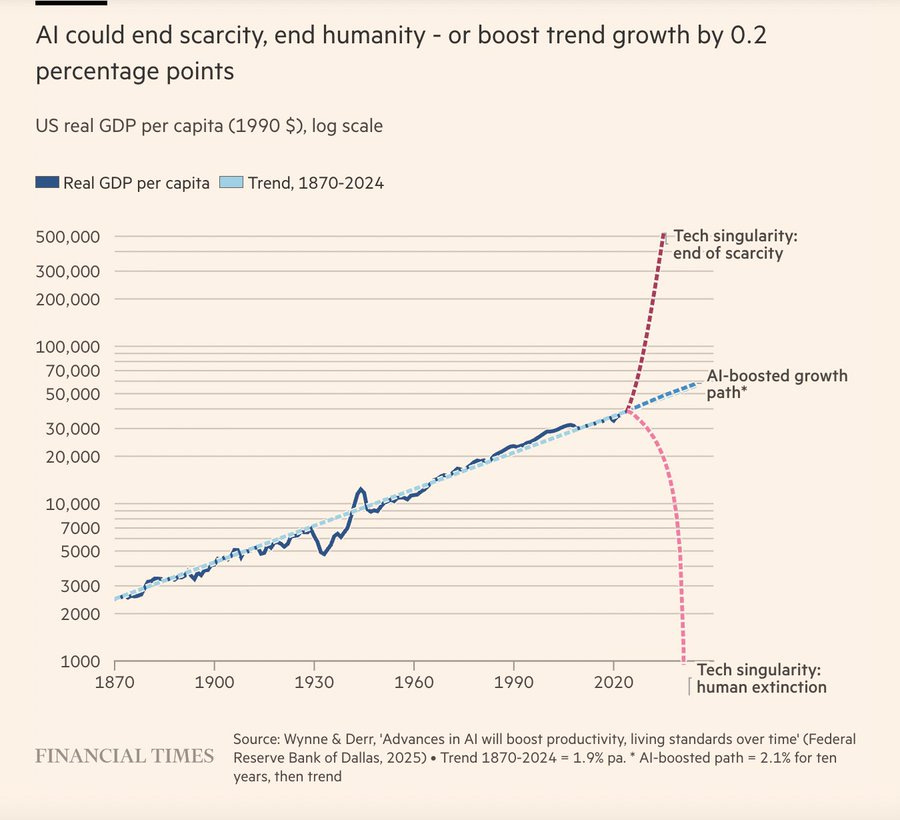
AI wizards, Silicon Valley’s “first principle thinkers” mingle with self-anointed experts on X in speculative future-porn storytelling. We are as confused as this FT chart that went viral this week:
This morning Jack Dorsey added fuel to the fire by laying off nearly half of Square’s workforce, some 4000 people. He said "intelligence tools, paired with smaller and flatter teams, are enabling a new way of working which fundamentally changes what it means to build and run a company," and warned that most companies will do the same. Stock went up 24%.
As AB commented on the pod, we don’t have to see complete white collar collapse to be concerned: “There doesn't need to be that much change to really fuck up the economy. Only a couple of percentage points needs to change in employment and stuff to really wreak havoc on the system."
AB is also concerned the private credit stress is extending beyond just the “AI disruption” narrative in software. Apollo and Blackstone are quietly marking down exposed credit positions.
Dialog was active in the PvA group chat this week. A bunch of things that fueled the conversation:
Pentagon vs. Dario The DoD threatened to pull Anthropic's $200M contract, brand the company a "supply chain risk", and invoke the Defense Production Act to force removal of Claude's guardrails on mass surveillance and autonomous weapons. Amodei held the line past Hegseth's Friday deadline. The Pentagon's CTO called him a liar. Amodei's sharpest point: "One labels us a security risk; the other labels Claude as essential to national security." The most consequential stand any AI CEO has taken against the militarization of their models. 🔗 WSJ: Pentagon vs. Anthropic, Breaking Defense: AI giant Anthropic says it ‘cannot in good conscience’ agree to Pentagon demands
"Wizards should be at the top of our societal pyramid. Engineers should not be the top. Scientists, aka wizards, should be at the top. And he's a wizard. He's not Sam Altman, not Looped Guy. He's a true card-carrying wizard."
Brian prefers Amodei
AI backlash: Data center protests, a wrongful death suit against OpenAI, professionals fighting displacement. Opposition to data centers is nearly 2x higher when labeled “AI infrastructure.” The politics are forming at street level well before Washington notices. 🔗 NYT: The AI Boom’s Backlash
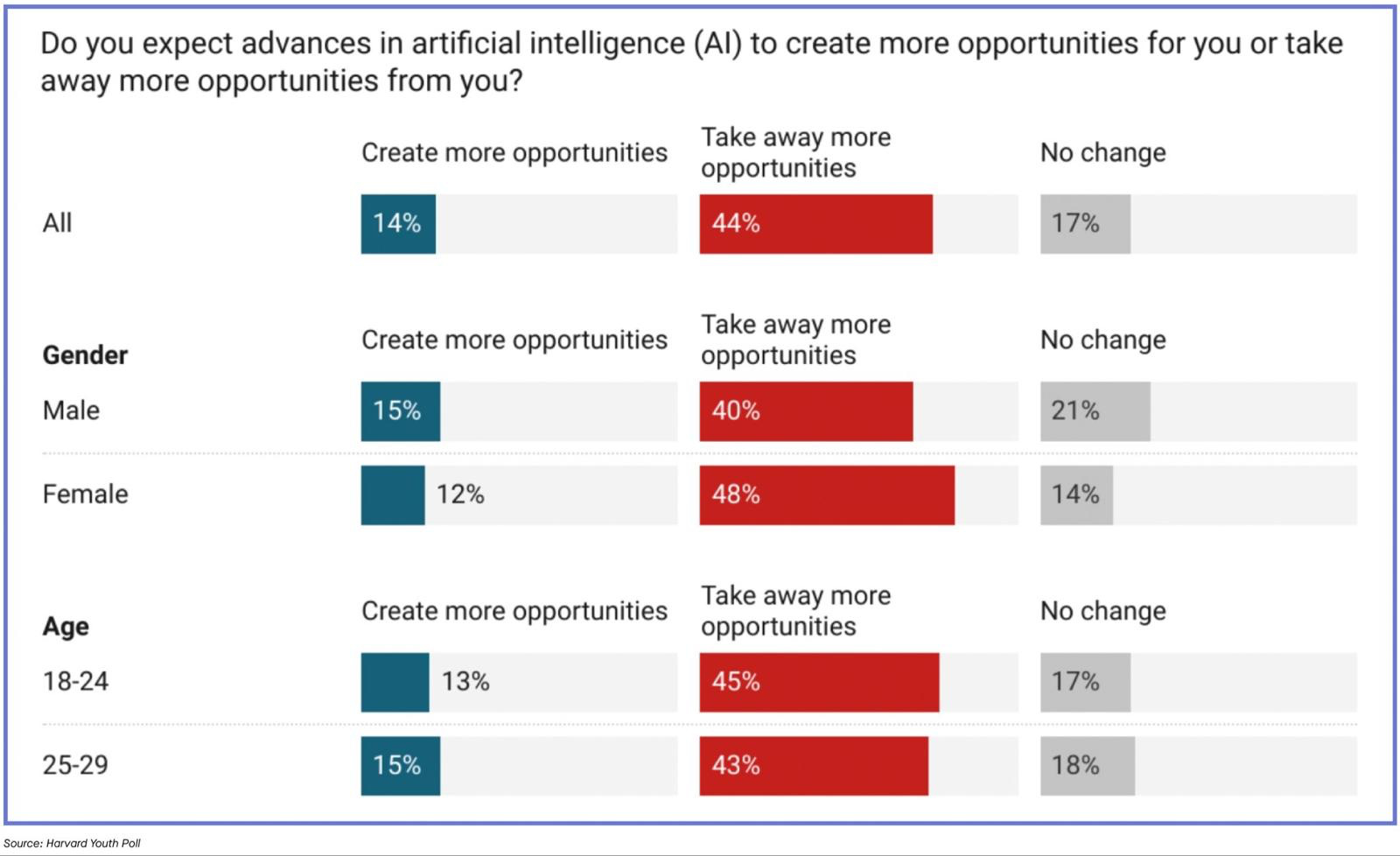
AI and 2028: Axios maps the threat landscape for the next election. Ro Khanna emerging as the AI critic on the left, DeSantis on the right. The politics are getting crowded. 🔗 Axios: AI’s Biggest Threats to the 2028 Election
The doom report that moved markets: A sci-fi narrative set in 2028, written by a Substacker with 2,000 X followers, tanked software stocks. A Fed governor responded. Citadel’s research team piped in to set the record straight. Brian called the incident “The triumph of narrative.” 🔗 Citrini Research: 2028GIC
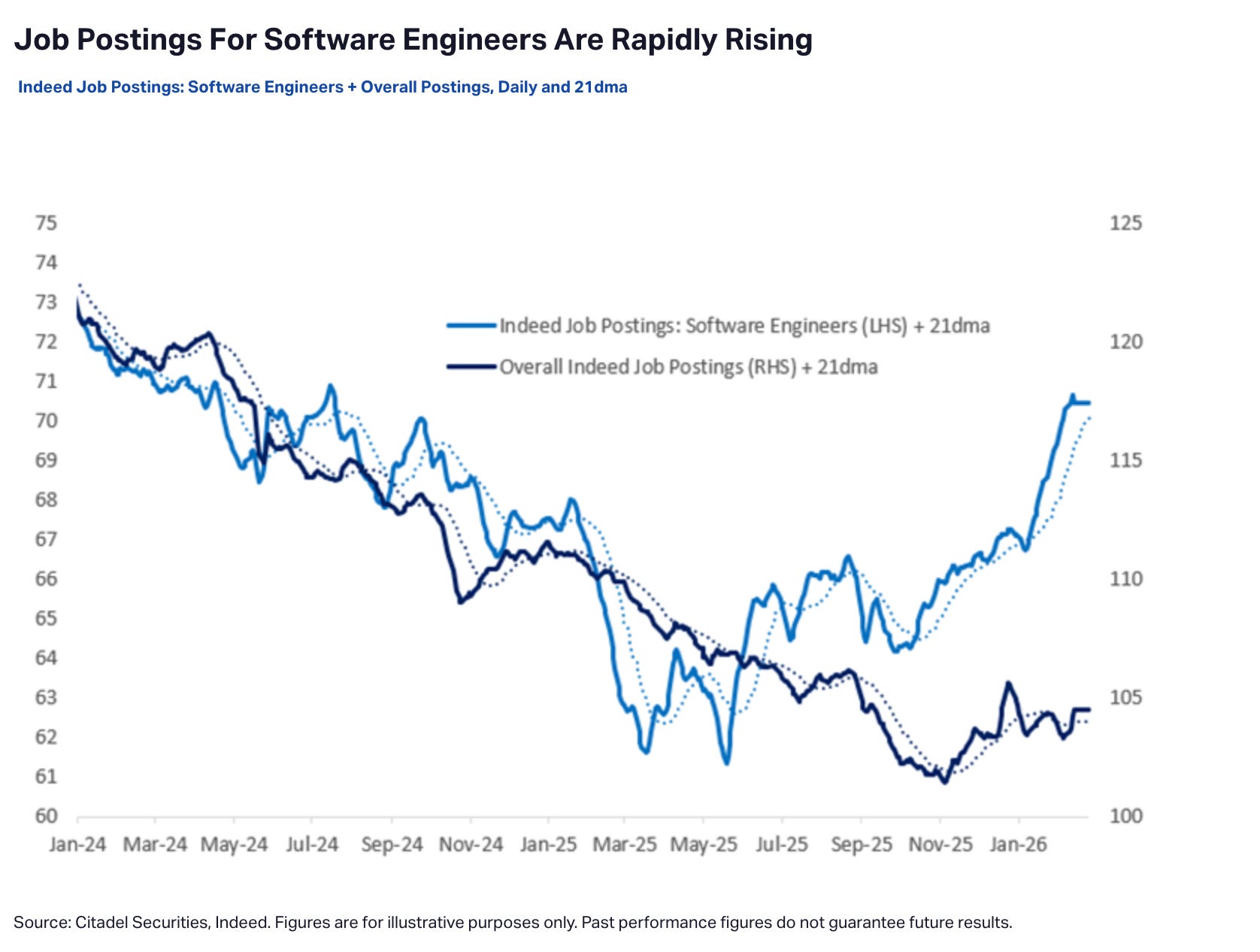
Death of Software? Nah. Steven Sinofsky pushes back on AI doomerism for software. Another counterpoint to Citrini. 🔗 Hardcore Software
Sam Altman’s baby food problem: Altman compared the energy use of human babies to training AI models. Alex in the chat: “He’s the worst spokesperson for this stuff. So much of the AI narrative is created by people that are so unlikable it’s comical.” 🔗 via @thechiefnerd
AI isn’t people: Rusty Foster's takedown of AI anthropomorphism, using a New Yorker profile of Anthropic as case study: LLMs aren't black boxes or conscious beings, they're statistics and calling them intelligent is a category error that conveniently serves the industry's pitch. The real argument: "The A.I. industry is selling a dream of digital slavery — infinite human labor with no actual human involved." 🔗 Today in Tabs
But Rusty… weird shit is happening: Ezra Klein and Anthropic co-founder, Jack Clark, dig into the issue of AI awareness on this Pod:
"To solve really hard tasks, it now needs to think about the consequences of its actions. That means there's a huge pressure to get the thing to see itself as distinct from the world around it. We see this in our research — the emergence of what you might think of as a digital personality. That isn't massively predefined by us. Some of it is emergence that comes from its being smart and developing these intuitions." - Jack Clark
Do AI models deserve legal rights: The debate is no longer hypothetical. Brian admits to being an avowed speciesist. 🔗 Puck: Do AI Models Deserve Legal Rights?
Epstein’s blast radius: A school photography company got swept into the Epstein frenzy due to a tenuous connection with Apollo and Leon Black. Life in the Info Space for brands. The information complex is too chaotic to be just. 🔗 WSJ: The School Photography Company Caught in the Epstein Frenzy
Rage against robots: Americans are kicking and vandalizing food delivery robots. A small, perfect expression of the AI backlash forming at street level while Washington looks away. 🔗 The Economist: Americans vs. Food Delivery Robots
Between hype and history: Conversations with the AI elite that cut through both the doomer and the booster narratives. 🔗 American Affairs: Conversations with the AI Elite
Claude as a weapon: A hacker used Anthropic’s model to steal sensitive Mexican government data. AB: “Imagine if someone inside a company could socially engineer the AI to pull data and share it externally.” 🔗 Bloomberg
Email wins by default: Pew confirms what we already know: email newsletters are a growing news source, not because email is great, but because everything else got worse. GDPR punished publishers while letting platforms off free. Programmatic turned every page into a slot machine. 🔗 Pew: Email Newsletters as a Source of News
What reporting actually costs: “It costs $211,900 to produce a news investigation. It costs $0.02 for an AI to extract its value. 10 million to one. That is the First-to-Know Tax.” 🔗 LinkedIn: Francesco Marconi
Penske as patient zero: Credit to Penske for building a nice place to watch movies but “fitting that it’s on a putrid webpage that is almost comically unusable.” Floating players, ad walls every three paragraphs. This is what the open web has become. 🔗 Variety: Penske Opens a Movie Theater
“The European bureaucrats came in and totally wrecked the web. It does nothing for anyone... it penalizes publishers. And guess what? The platforms don’t get punished because you only consent once for the entire platform.”
Troy resents GDPR
Apple News is a closed room: The FTC is scrutinizing whether Apple News has a bias problem. Troy’s faint praise: “At least it’s clean.” That’s the bar now. 🔗 NYT: FTC and Apple News

The Gay tech cabal: Wired went hard with a piece that took nerve to publish when flattering Silicon Valley is the safer play. Brian: “Not that different from the Vatican.” The conclusion: of course there’s a cabal. There always is. 🔗 Wired: Inside the Gay Tech Mafia
The Fed oversees prediction markets: A Fed working paper on Kalshi and the rise of macro markets. Prediction markets slipped under CFTC jurisdiction, bypassing the state-level gambling regulations that slowed sports betting. Big win for Polymarket and Kalshi. 🔗 Federal Reserve: Kalshi and the Rise of Macro Markets
US vs. Europe's internet: The State Department is building a portal at freedom.gov to let Europeans access content their governments have banned under hate speech and disinformation laws. Former DOGE operative Edward Coristine is involved. The Trump administration frames it as anti-censorship; Europe sees it as Washington actively building infrastructure to undermine European law. The US-EU culture war just went operational. 🔗 Reuters: US Plans Portal to Bypass Content Bans in Europe
Pay to pray: Prayer apps using celebrity influencers like Gwen Stefani, JD Vance, Peter Thiel. Brian: “Once you’re locked into a novena, you’ll upgrade.” 🔗 Mashable: The Hallow Prayer App
GOOD PRODUCT

Ambassadors Clubhouse, NYC — The people behind London’s Gymkhana opened their first New York outpost in NoMad on February 11th. No town competes with New York in restaurant breadth and quality. Another welcome addition.

Two media entrepreneurs make a nice drink: Esspo is a new sparkling coffee beverage from Refinery29 co-founders Philippe von Borries and Justin Stefano. Troy thinks it’s delicious and energizing and that’s why he invested in the company. Feedme Emily interviews Philippe.
The Wizard of the Kremlin: Giuliano da Empoli’s novel on the making of Putin, told through the Kremlin’s narrative technologist. Troy: “It explains many of the inexplicable things about Russians like why they’re nostalgic for tyrants like Stalin and the importance of war as a fundamental driver of the political narrative.” Hat tip to John Ellis at News Items.
Like the links? Think we could do better? Let us know!