


Hola cheaters…
It’s still your dirty little secret. Like cheating on taxes.
Soon it will be normalized, demanding new conceptions of creative ingenuity. I don’t see a way around this.
It should come as no surprise that any enterprising creative mind finds AI a formidable thinking partner. An easy lover. The Deniers will be disadvantaged, even if there will always be demand for certified 100% Grade A human expression.
Take two recent examples as evidence of the coming landslide.
The literary world erupted when Granta published a prize-winning short story that many obviously adored, while others accused it of sounding a little too AI-generated.
Soon after publication, readers online began pointing to what they described as those classic AI markers: unlikely metaphors, repetitive “if x then y” sentence structures, stylistic overproduction without emotional coherence.
Was it AI? Who knows. It’s getting harder to tell.
Granta tried to find out by submitting the disputed story to Anthropic’s Claude model and asking it to evaluate whether the story appeared AI-generated. According to reporting, Claude responded ambiguously.
People found the logic of the situation absurdly recursive. A major literary institution accused of publishing AI prose responding by asking another AI to judge the authenticity of the writing.
Meanwhile, in other recursive news, the bespectacled digital media “guru” Steven Rosenbaum was accused of an even more egregious act of professional irony. His book, The Future of Truth, a stark warning about AI’s distortion of reality, was itself found to contain fabricated, AI-generated quotes.
Clearly, even the people and institutions trying to police the boundary between human and machine are struggling against its gravitational pull.
But policing this stuff feels increasingly futile and beside the point. If only it were as easy as drawing a blood sample from Lance Armstrong’s steroid-enhanced forearm. Instead, entirely new forms of AI-assisted creativity are going to emerge, and only the public and the algorithms will decide if they’re worthy.
Elsewhere, the Cannes premiere of Hell Grind, billed as the first fully AI-generated feature film, offered an early look at what AI-native filmmaking actually involves in practice. The creators boasted that the movie was made in just a few weeks by a small team. They also described an unexpectedly labor-intensive process involving massive compute costs, 3,000-word prompts, and tens of thousands of generations just to produce usable scenes.
What stood out wasn’t a “push button, get movie” future, but rather the emergence of a new creative workflow: part filmmaking, part systems engineering, part prompt orchestration. And the Academy Award for Best Prompt goes to…
I asked my podcast co-host Alex about this. “The real challenge right now isn’t a high-profile author getting pulled out for doing it too noticeably,” Alex argued, pointing to the open floodgates. “It’s the lower end that’s really feeling the crunch because they never competed at a level of artistry that gave them any moat whatsoever.”
When it comes to the higher end of creativity, he remains a realist about what these systems actually do. “A lot of what AI does is just bad writing that is not compelling,” he noted, though he sees the inevitable shift in workflow. “I don’t see why you couldn’t create an outline of a book with AI where you drop all the ideas and then fill in the rest and humanize it in multiple passes. A sort of reverse edit.”
But to cross the line from mass-processed content to culturally resonant media, his conclusion hits the nail on the head: “Everybody can write a mediocre novel now, even me. But to have a hit, you need to create something new and surprising. These tools are mostly rehashing what existed before; the human in the loop must make it great.”
That still feels true. AI remains weak at generating the genuinely new and surprising. But while new formats will eventually emerge, our immediate issue is much simpler: the floodgates are open. We suddenly have a massive supply problem for all manner of content and creativity.
Of course, if you stretch all of this toward the dystopian singularity horizon, concepts like authorship and provenance dissolve entirely. Who really gives a fuck as to who created what when AI can serve deep feels to us dumb humans suspended motionless in vats of gooey saline?
The more likely outcome: we go full Steroid Olympics, drop the corny labels, stop pretending purity is enforceable, accept the new enhanced reality and embrace a new kind of augmented creative athlete operating inside new definitions of creative excellence.
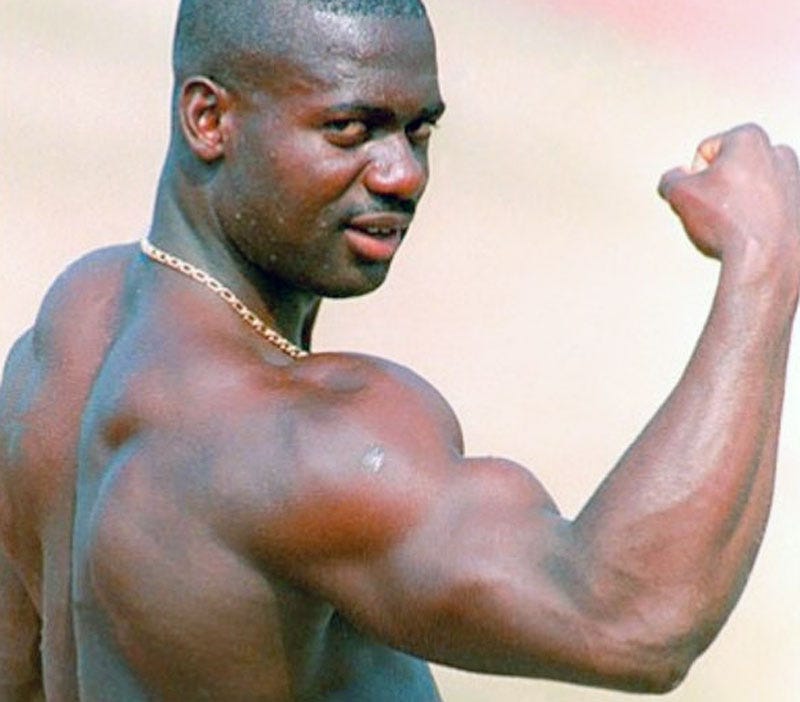

Pod 184: Steroid Olympics
Out FRIDAY 6 AM EST Apple | Spotify | Substack
People are booing AI, then turning around and using it. This week, we discuss the chaotic transition to an AI-augmented era, the roiling backlash trying to slow it down, and how we’ll come to terms with a weird new world. Plus: The dénouement of the scale era in publishing and the beginning of the “inversion” era of media brands.
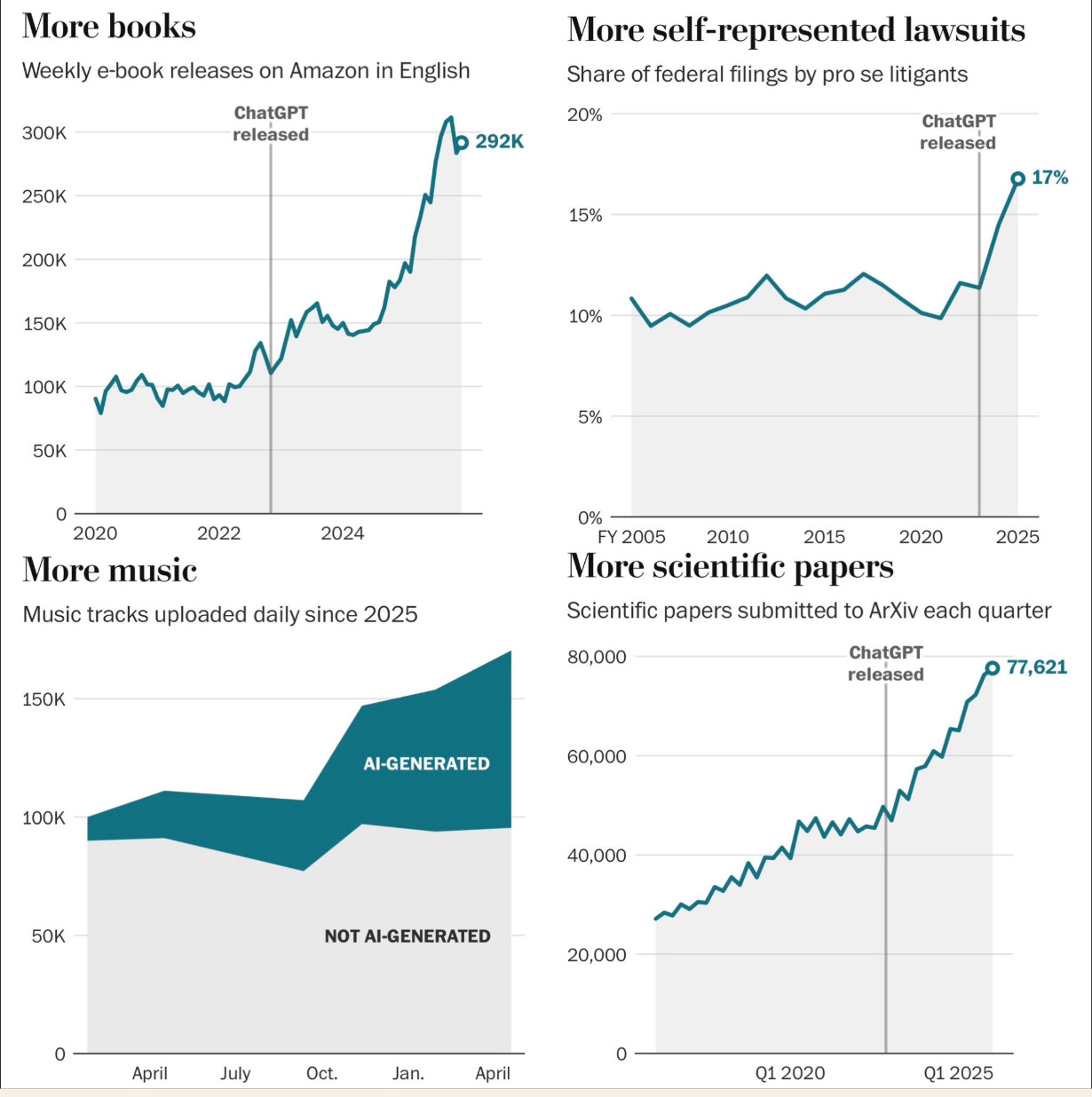
What happens after generative AI escapes into the wild: more books, more music, more lawsuits, more scientific papers. Amazon ebook releases have nearly tripled since ChatGPT launched. AI-generated music uploads are exploding. ArXiv submissions keep climbing. Even self-represented federal lawsuits are climbing as legal assistance gets cheaper and more accessible. The common thread is volume, not replacement. AI lowers the activation energy for production everywhere, flooding systems already struggling with abundance, curation, and trust. The bottleneck increasingly shifts from creation to filtering what matters. » Wapo: These 5 Charts Show How ChatGPT Is Flooding Our Lives
The AI boos continue at graduations just as the Vatican prepares what amounts to a modern Rerum Novarum. Pope Leo XIV is releasing an encyclical focused on AI, labor displacement, and human dignity, explicitly invoking the Church’s response to the Industrial Revolution. Anthropic co-founder Christopher Olah will appear alongside the Pope at the launch. Ancient institutions seeking relevance. Frontier AI firms seeking legitimacy. Populist distrust rising precisely as elite coordination around AI accelerates. » Vatican News: Pope Leo XIV’s First Encyclical Magnifica Humanitas to Be Published May 25
Will Manidis added a new one this week: “grindslop.” His argument is not that startup culture resembles meaningful sacrifice, but that it imitates the aesthetics of suffering without any larger spiritual or political purpose behind it. Founders sleeping in offices, working seven-day weeks, tattooing company logos onto their bodies. Wealthy knowledge workers voluntarily recreating the conditions of factory labor as public performance. Manidis argues the ritual exists because modern elites no longer feel comfortable simply being rich. Wealth now requires visible exhaustion to appear morally legitimate. The company itself becomes incidental. The suffering is the content. » X: On Grindslop
Google finally stops pretending. At I/O the company reframed search from “find information” to “delegate cognition.” AI answers over links. Agentic task completion over browsing. Personalized synthesis over publisher traffic. As one analyst put it, publishers are increasingly being reduced to “raw data providers” feeding Gemini-powered experiences that answer questions without sending users away. The web survives as infrastructure, but the economic bargain underneath it, free content in exchange for distribution, is over. » NYT: Powered by A.I., Google Changes Its Search Box for the First Time in 25 Years
Tucker Carlson’s demon attack story sounded ridiculous until you notice the broader pattern. Astrology surges. Orthodoxy gains cultural cachet. AI destabilizes confidence in reality itself. Once institutions lose authority and digital media floods the zone with synthetic evidence, conspiracy, mysticism, and supernatural thinking rush into the vacuum. When nothing feels verifiable, metaphysics becomes competitive again. » NYT: Why Americans Are Returning to the Supernatural
GOOD PRODUCT
Hadrian’s Hangout
I’ve been in Italy all week. Lots to choose from. This was a great outing.
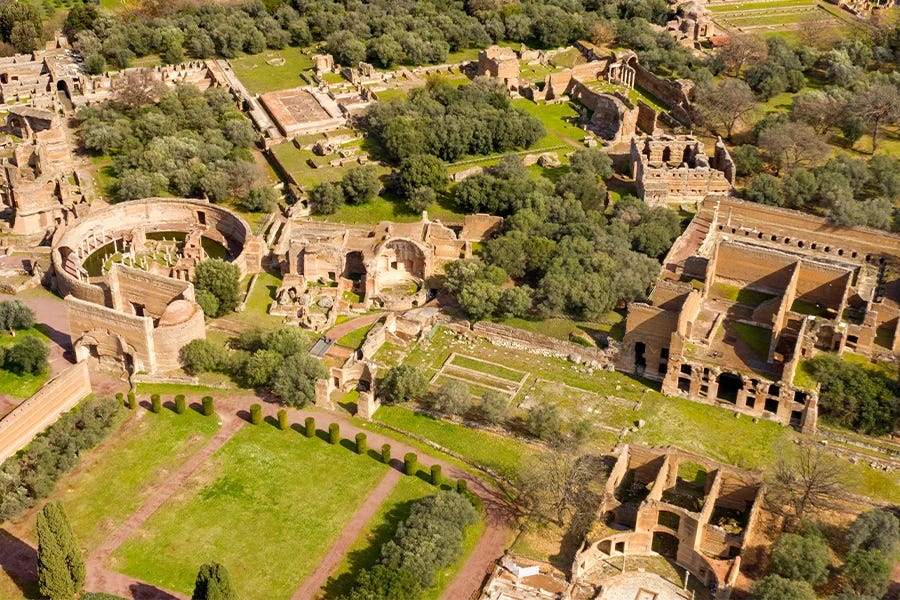
Wandering through Hadrian’s Villa outside Rome, you start to understand that he wasn’t a conquering emperor in the classic Roman mold but an obsessive systems thinker taming a sprawling empire. Restless, intellectual, deeply controlling, fascinated by architecture, philosophy, engineering, and Greek culture. The villa was less a palace than a private world-building exercise: libraries, baths, theaters, reflecting pools, underground service tunnels, even replicas of places he admired from across the empire. Now it sits in fragments outside Tivoli, the ruins of someone who believed design, taste, and contemplation might briefly hold chaos at bay.
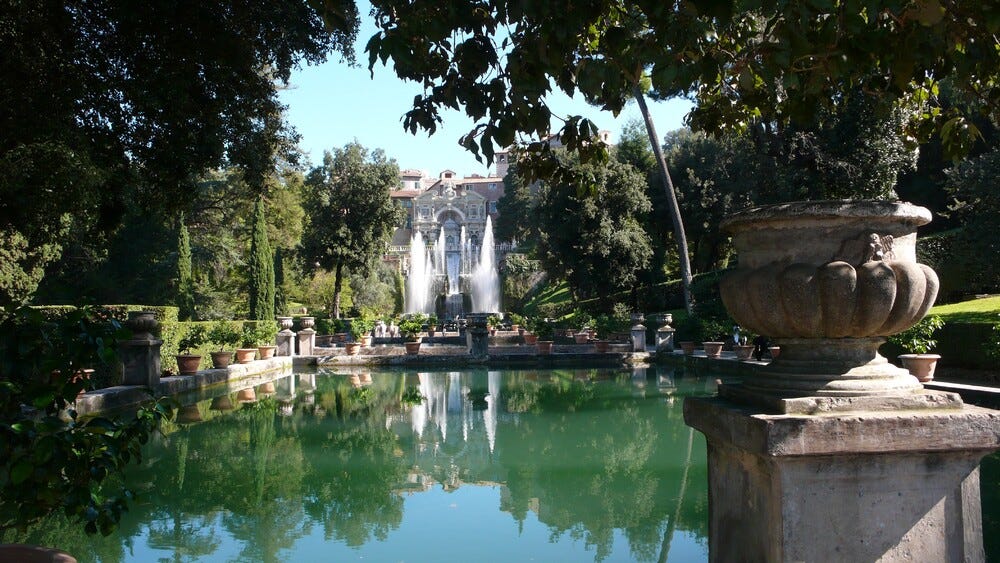
Only 30 minutes outside of Rome. Pair the trip with a visit to Villa d’Este nearby, also a UNESCO site. » UNESCO: Villa Adriana (Hadrian’s Villa)