


Morning Earthlings,
Twenty years ago I was reading a New York Times Magazine profile about Rick Rubin joining Columbia Records. The label was jointly run by Rubin and Steve Barnett. Barnett was a footnote in the piece, except for one detail that stuck with me. According to the article, his office was cluttered with music memorabilia. Behind his desk, above a large framed portrait of Johnny Cash, was a sign that read: “Your Faith Needs to Be Greater Than Your Fear.”
“I have always believed that,” Barnett told the writer.
I read it over and over.
It made a lot of sense to me too; a useful reminder for someone who often confuses control with faith. Shortly after, while visiting a friend in Manhattan, I decided to make it a permanent reminder by etching it on my skin. I borrowed her computer, fired up PowerPoint, and typed the more efficient “faith > fear” in Helvetica. I printed it out to take to a nearby tattoo parlor on the Lower East Side. My friend had a couple of Valiums lying around and kindly offered me one as a trusty companion for the journey. Being free-spirited, she joined the adventure and had a variation of the same mantra needled into her forearm. Despite my own uneven commitment to the principle, it has proven a useful reminder on occasion.
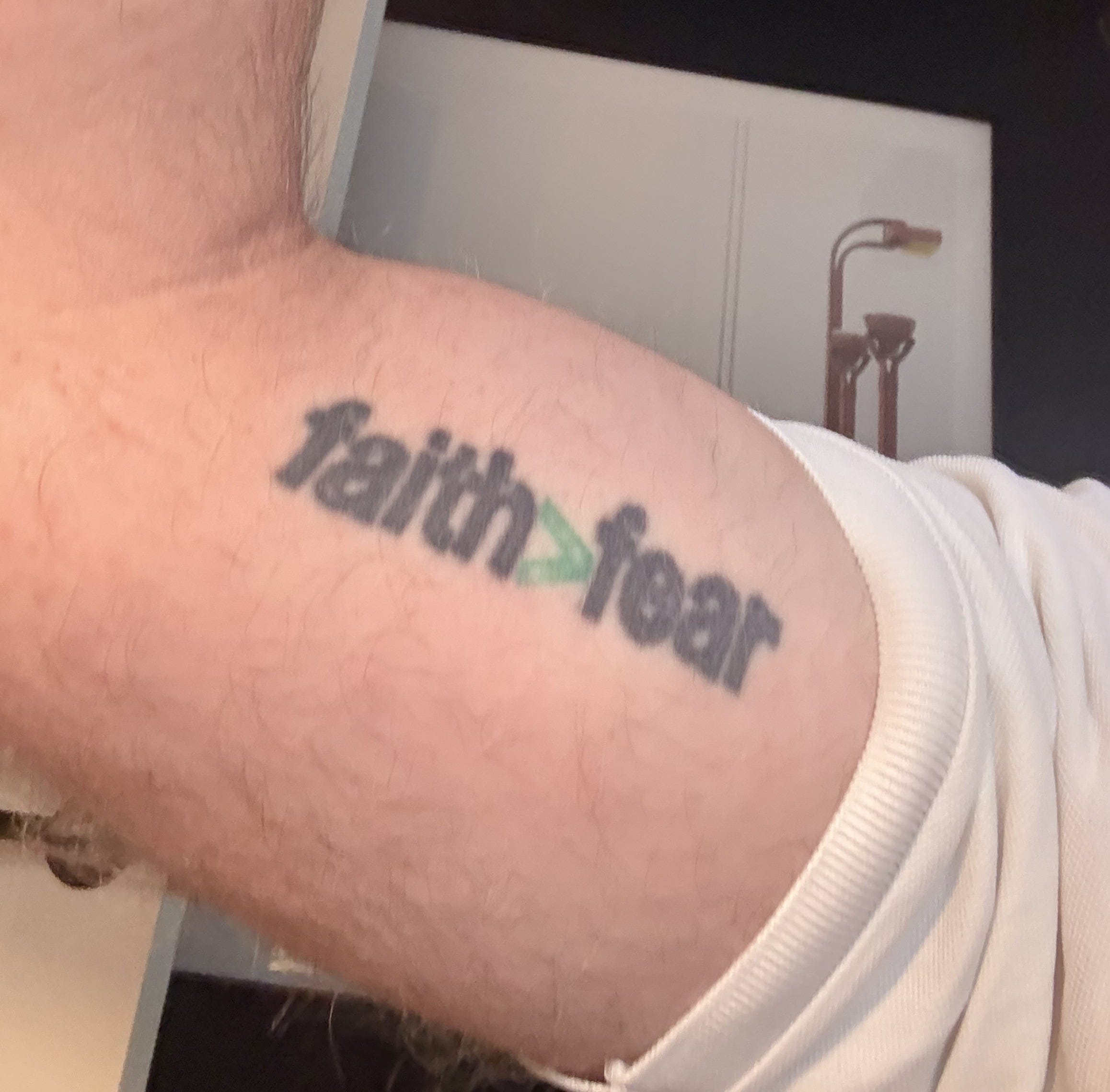
I thought of it today as I was trying to reconcile how I feel about AI.
The people closest to the technology sound either ecstatic or terrified, and often both in the same interview. The rest of us are left trying to decide whether AI is social media, electricity, nuclear weapons, or God on earth.
Bezos sees new jobs. Dario sees mass unemployment. Elon says you’ll work if you want to. I mostly do the old man thing, emboldened by my libertarian bent. It’s fine. I’ll send the kids Mac minis so they can set up OpenClaw. They can figure it out or risk irrelevance.
Not because I know “it’s fine.” Because “it’s fine” is what men of a certain age say when the complexity-to-control ratio gets too high. A spell against panic. A comfortable way to file uncertainty. The basement is flooding. The kid is crying. The market is collapsing. The machine may eat the world. It’s fine.
The Anthropic organization embodies all the contradictions of an arsonist selling fire protection. Dario Amodei is its perfect mascot. A wizard capitalist with a conscience. Acknowledging the burden, he recently told the FT that AI should be regulated like cars and airplanes — a nice analogy that makes the future sound reassuringly administrative.
But AI is not a car or an airplane, at least not if you believe what its builders actually claim. AI is being sold as a new substrate for knowledge, labor, persuasion, science, education, war and companionship. The risk is that it changes the road, the driver, the destination and the meaning of travel. This is the Anthropic conundrum: merchandise the upside, cop to the risk, and if possible, leverage it to support the business case. Ask for regulation before you become too powerful to regulate.
Anthropic seems comfortable with the ambiguity. This week they hired Chad Jones, a prominent Stanford economist who has written extensively on the trade-offs between AI-driven growth and existential risk. In one paper, Jones modeled a scenario where it could be “optimal” to accept a roughly a one-in-three chance of ending human existence in exchange for a two-in-three chance of raising living standards by a factor of 55. It’s just math.
The new emotional burden of AI is idiots like me being asked to have a position on the probability of human extinction.
The new emotional burden of AI is idiots like me being asked to have a position on the probability of human extinction. So, I make up my own numbers, because everyone else is. Twenty percent doom. Thirty percent utopia. Forty percent some weird middle state where we survive somehow. What are you supposed to do with a number like that? Buy canned goods? Short Salesforce? Hug the kids? Learn some Python? Run for Senate? Drink the good whiskey?
One of the nice contributors to our PvA Field Notes community just shared an article from Asterisk Magazine that brought me a small amount of clarity. The opening question: “What is it like to live in a world you believe is about to end?” The writer put it to a bunch of smart people in the AI business. Their answers point to where I think this all has to land. One offers: “It’s better to have died having fun on the trampoline than to have died listening to Moonlight Sonata on repeat while I cry.” Another, cleaner: “If you’re living your life well, you should always die with half-built pyramids.”
Which brought me back to my fading tattoo.
Faith greater than fear is not optimism or a promise that everything works out. Optimism is a forecast. Faith is a posture. Optimism is unvalidated hope that things will bend your way. Faith is what you use when the evidence is mixed, incomplete, terrifying, or unavailable.
The divide over AI cannot be settled intellectually. It requires faith. Like do you believe that we can adapt. That we can build institutions around a new form of power before the power outruns the institutions. That is where the doomer and the zoomer really split. The doomer does not trust us to coordinate in time. The zoomer trusts adaptation. The regulator trusts process. The old man trusts that civilization has always been a rolling catastrophe held together by duct tape, incentives, shame, greed, love and a few useful rules.
I am not sure which is right.
I only know fear is not a plan. “It’s fine” is not much of one either, admittedly.
That tattoo has not made me wise or brave. It might have made me aware of how often I am neither. But it remains a useful instruction. Not because faith trumps fear in some cosmic arm-wrestling match. Because fear is clarifying only up to a point. After that it just gets in the way.
Build the pyramid. Learn some Python. Drink the good whiskey. Regulate the airplane. Keep one hand near the emergency brake.
Faith greater than fear, even if only barely.
Pod: Cannes is CES with Rosé
Out FRIDAY 6 AM EST Apple | Spotify | Substack
This week’s episode leans heavily into Cannes, which is a world where everyone is selling and many are lying. Creators are the cool kids of Cannes, while the site of a drone show by a mobile ad network is considered normal. Plus: Ana Andjelic on what makes A24 unique.
Enjoyed this a great deal. I think my version of "it's fine" is "it'll work out". I truly do think it'll work out. Hard for me to believe that it won't.
I look at a generation of kids who have been sort of decimated by social media. And then I look at the generation a bit younger than them, still working their way through school. They celebrate the analog moments in life and are nostalgic for "the 90's", which I am starting to see more to mean more human connection and fewer digital worlds than anything else.
The pendulum swings and things balance out. Society adjusts. Business adjusts to the desires of society. The biggest risk of AI is that it launches nuclear bombs at us all willy nilly. But we've had nukes for a long time, and we haven't ended the world yet. Just kind of interesting.
If I'm wrong we'll all be gone and you can't prove me wrong anyway.
👏👏👏