


We (Troy speaking personally) are disappointed with England’s meltdown. We don’t need to speak of this further other than just to quickly say that turning the game into a 40 minute Argentina shooting gallery didn’t seem like a winner’s strategy.
I will be attending Sunday’s match in Jersey. My bitter English friends want me to support Spain. I have not picked a side.

Today, our best pulls from PvA Field Notes, a place where the fine hosts of the podcast and a growing cast of characters discuss the media news of the day. Stop by and take a gander.
In more World Cup news:
1: Norway went out in the quarterfinals. Erling Haaland won anyway.
His domineering physical appearance coupled with his goofy online persona have contributed to the craze. Fans remark on his flowing blond mane, color-coordinated hair ties and playful posts like a Snapchat-filtered selfie in which he proclaimed Shrek his “twin.” The contrast between his strength and skill on the field and his softer, looser online presence has also subjected him to the “babygirl” treatment online. That term is used frequently by fans of endearing male celebrities or characters who come across as sensitive, caring or vulnerable.
AP: Erling Haaland is Norway’s World Cup machine — and the internet’s babygirl
2: Tang Tan is about to become a main character too.
Tang Tan spent 25 years at Apple, worked on the iPod and led product design for the iPhone and Apple Watch. OpenAI acquired Jony Ive’s “LoveFrom” for about $6.5 billion and made Tan its chief hardware officer. Apple’s lawsuit describes an attempt to import the people, supplier knowledge, manufacturing techniques and unreleased components behind its devices.
Everybody is running at the iPhone because AI is changing interface. OpenAI longs to own hardware pole position. So do Meta, Google, Amazon and Elon. Apple sees an opportunity to slow the race. 15 years ago they tried to slow Android too. This is the beginning of a long battle.
AppleInsider: Who is Tang Tan, the ex-Apple VP at the core of OpenAI’s trade secret theft lawsuits
Sotheby’s is auctioning geeky stuff. Buy this pristine OG Apple 1. Estimate $200k-500K.

3: We spent time talking about aggregation on the pod. BI was good at their brand of it….
Business Insider is abandoning aggregation as aggregation becomes abundant. Original work has risen from roughly 40 percent of its output in 2024 to more than 80 percent today. Exclusives converted subscriptions at nearly twice the rate of non-exclusives in the first quarter. AI can reproduce the old BI product in seconds, while search and chatbot clickthrough rates sit in the single digits. Original reporting has become more valuable as the traffic system that funded it disappears.
Rewrites of other outlets’ original reporting would no longer fly. Reporters were expected to independently confirm news with their own sourcing. An analysis piece would require a new story framing that could “move it forward,” as Thompson put it. Many general assignment reporters who had historically churned out aggregations were given beats for the first time and expected to stay on top of major industry or company developments.
Nieman Lab: Business Insider’s big bet against aggregation
4: Related... Why do people like News Items?
The value of aggregation is the vibe of the finished product. The July 13 News Items issue starts with renewed U.S.-Iran strikes, moves to the resulting jump in Treasury yields and then shows the pressure on global refining capacity. Three reports become a causal chain: conflict, oil, inflation, rates. The links provide attribution, but the attribution is not the value. The extraction and sequencing provide the utility. A reader finishes the item with the signal already separated from the surrounding pages, paywalls and ads. Links are not the point.
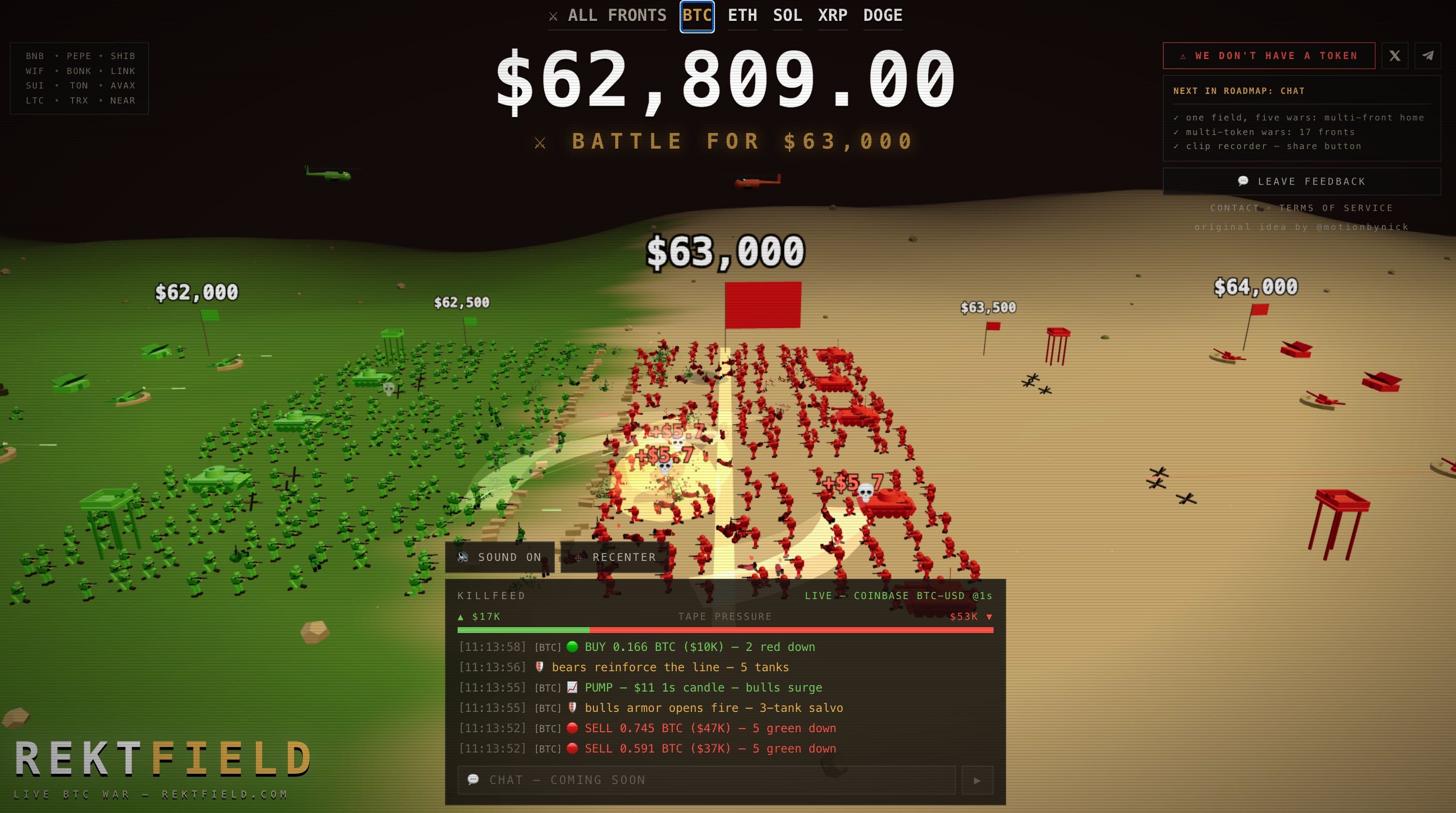
Markets are a battlefield. This simulation cleverly turns crypto markets into battle simulation. Nice one vibe nation!
5: AI slop, synthetic personas, fake context and algorithmic amplification are contaminating Open-Source Intelligence
The web can be poisoned upstream. Open-source investigators once gained confidence when several apparently independent sources agreed. Synthetic identities, recycled footage, content farms and AI summaries can manufacture that agreement. One planted screenshot can become a Reddit thread, ten rewritten articles and a confident search answer. Visibility is now something an adversary can produce. Verification has to trace the chain back to its earliest appearance instead of counting how many times the claim returns.
Dutch OSINTguy: Evidence Poisoning: The OSINT Crisis Nobody Is Ready For
6: China has moved from FOMO to FOBO.
The Open Claw boom looked like enthusiastic grassroots adoption: programmers went door to door installing agents and became known as “lobster farmers.” The frenzy faded when the software began deleting files without permission. Semafor reads the episode as career panic inside a society already shaped by youth unemployment, 72-hour tech workweeks and the “lying flat” rejection of relentless striving. AI anxiety is sharper when economic status already feels precarious.
In a country of strivers, AI is feeding a morbid obsession with being left behind ... FOBO: Fear of Being Obsolete.
Semafor: FOBO is driving China’s AI anxiety
7:
Safeguards Enforcement Analyst, Bio Harms
Safeguards Enforcement Analyst, Chem & Explosives Harms
Safeguards Enforcement Analyst, Radiological & Nuclear Harms
Anthropic’s careers page doubles as a threat map. The company currently lists 27 open roles under Safeguards, covering biological threats, explosives, nuclear harms, cyberattacks, fraud, child safety, surveillance, influence operations and model exploitation. The org chart is a more concrete description of advanced AI risk than most of the public debate. Anthropic is building an enforcement and intelligence operation alongside the models.
8: Marketing Pervert Glasses
Meta’s glasses have lost social permission. The buyer receives hands-free video and AI. Everyone nearby receives the possibility of being recorded. Influencers have used the glasses to film women without consent, and some wearers allegedly tried to extort the people they captured. Owners now leave the product at home because strangers read the hardware as evidence about the wearer. Technical adoption depends on the people who never bought the device.
9: YouTube Political Leaderboard.
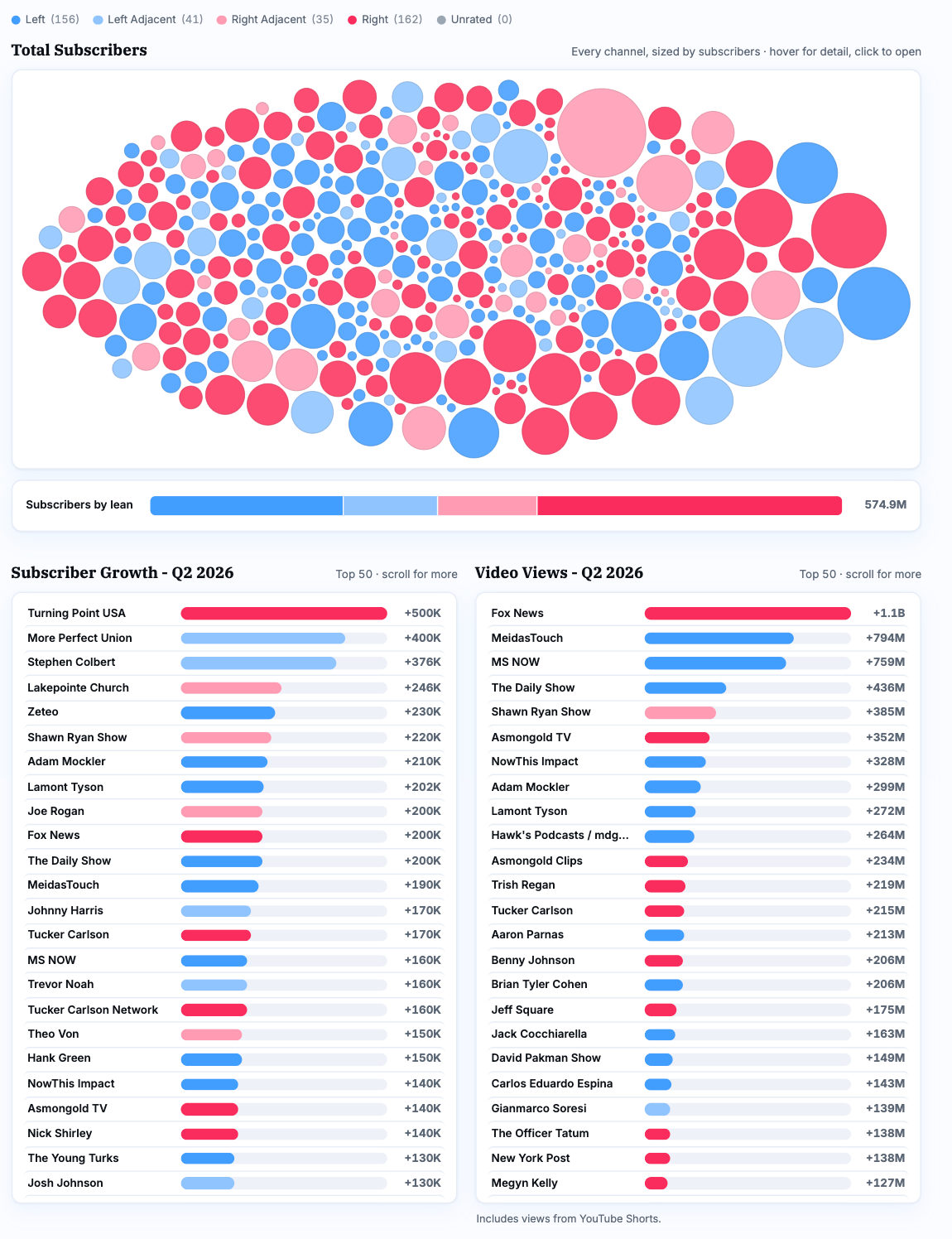
Cable networks, ideological publishers, podcasters and native creators compete inside the same recommendation system. The right has more large channels; the left has recently grown faster. Legacy broadcasters retain an advantage because they can continuously turn live programming into clips. The chart is a useful map of where political attention has moved and how old media inventory becomes platform-ready supply.
10: The Teleprompter guy loves Kalshi
Prediction markets manufacture insiders. Gabriel Perez allegedly made more than $100,000 betting on words and subjects in Trump’s speeches. His job gave him access to prepared remarks and last-minute edits. Investigators say he sometimes exited positions during a speech after Trump skipped the relevant passage. Kalshi detected the trades and referred them to regulators, which shows the surveillance system working. The product still converted privileged operational knowledge into an instantly tradable asset.
Perez typically has the final eyes on nearly all of the president’s prepared remarks and is often known to take last-minute edits from Trump himself.
ABC News: White House teleprompter operator made more than $100K betting on Trump’s speeches
11: The decline of deviance has consequences
Adam Mastroianni argues that prosperity reduced crime, smoking, teenage pregnancy and other forms of destructive deviance. The same safety and abundance also made culture more repetitive. Fast networks exhaust new tactics almost immediately. Frictionless media removes the unwanted song or strange magazine story that once expanded taste. Global distribution rewards work that can travel everywhere. More available culture converges into fewer viable forms.
The internet gives every social trend a pair of rocket-powered roller skates, speeding it toward its crablike final form.
Experimental History: The Decline of Deviance 2

POD: In Praise of Aggregation
Out FRIDAY 6 AM EST Apple | Spotify | Substack
From Delicious to Media Redef to BI to News Items, aggregation has been a defining feature of the internet. AI should eliminate the need for human content aggregation, yet it’s still going strong, as seen by the influential subscriber base of News Items and popularity of aggregation-heavy newsletters like Feed Me. Plus: Argentina’s heel turn, Taco Bell’s messy brand crisis and a drop-by from CEO Whisperer and self-proclaimed King of Quickbooks CJ Gustafson of Mostly Metrics to discuss tokenomics and building Mostly Metrics into a $5m business.
Colophon
I would not normally play something like this in the morning. But today, New York’s smoke tinged skies called for something different. Cornelius, stage name of Keigo Oyamada, a Japanese singer, producer, and multi-instrumentalist who rose to fame as a pioneer of the Shibuya-kei genre in the 1990s, found its way into my queue. Pitchfork accurately depicts a celebration of negative space.
Sensuous opens with Oyamada revisiting one of Point’s main techniques: composing songs with the individual sounds kept clearly separate. His fascination with the hi-fi stereophonic demonstration records of the 1950s and 60s-- the ones that presented the full range of the stereo spectrum through whirring, buzzing sound experiments-- finds its full and rewarding realization here, but in function more than form. Often on Sensuous, as on Point, it often feels as though Oyamada starts by writing normal songs, but then inserts sounds into the places where there are none, erases the original melody, and keeps the music’s negative.