


There are roughly 218 million active websites on the internet today, spread across more than 300 million domains. We are talking about a product that has, at least historically, profound product-market fit. Even if that growth has plateaued.
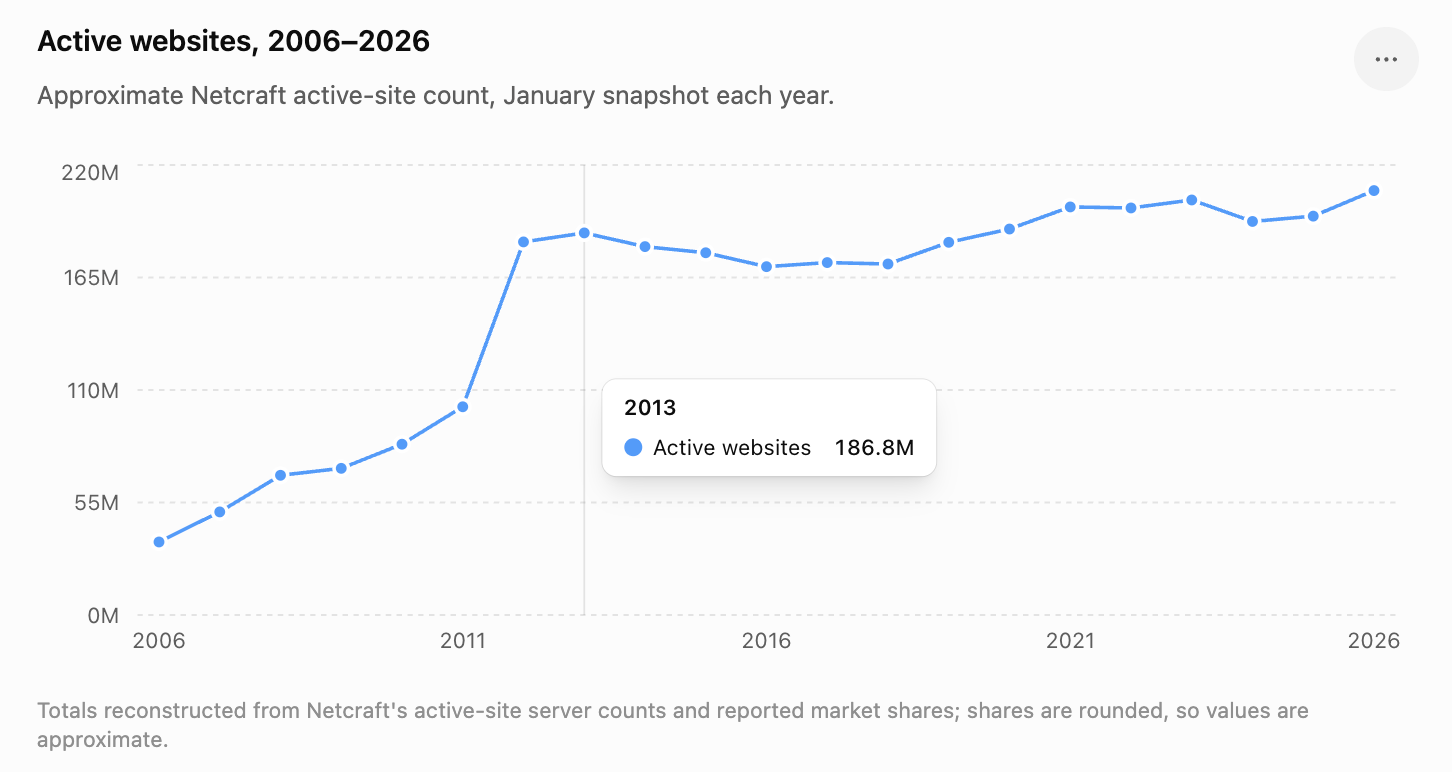
I bring this up because there is suddenly a lot of talk about the internet being dead. I would like to take a minute to examine what exactly is dying, why it is dying, and speculate a little about what comes next.
For clarity, what is this thing we call the internet when we say it is dead? We mostly mean the Web. The internet is the network underneath everything. The Web is the thing Tim Berners-Lee and others built on top of it: an open system for publishing, finding and connecting information.
It is defined by a few good ideas.
There are open standards and protocols that allow anybody to make and read the stuff it contains. There is a universal addressing system — URLs — so everything can have a location and everything can link to everything else. There is a discovery machine… Google. Then there is an economic model, mostly advertising, that kinda works but has never worked particularly well.
Mostly, we love that it is free of nasty central control. This is why we call it the Open Web. You want a website, you can make one. Put whatever you want on it. Design it however you want. Make it fugly. Sell ads. Or subscriptions. Nobody at Apple or Meta needs to approve.

Berners-Lee once explained the idea nicely: “You can’t propose that something be a universal space and at the same time keep control of it.”
That was cool. But there was a little problem.
Platforms came along, and for most people they were just better products. Instead of navigating millions of individual websites, you got one navigational construct for everybody’s stuff, mostly the feed. That was nice for most people. As the internet shifted toward photos, rich media and then video, platforms did all of that better too.
The platforms leveraged scale to build vastly superior advertising machines. They also did all the hard technical stuff inside tidy gardens: identity systems, social graphs, comments, messaging, authentication, payments, moderation, security and analytics. All the complicated shit that an individual publisher or creator had to wire together themselves got absorbed into a few giant planned communities.
Platforms scaled away complexity and made the Web feel clunky.
Over time they sucked more and more of its creative and economic energy. Platforms made it much easier to be an independent creator. People seemed comfortable with the trade.
Do not underplay monetization in this power shift. The Web ad model embodies 20-plus years of human toil and it still sucks. Banner ads led us astray. Identity was never core to the architecture. Payments were basically bolted on later. Publishers need unattainable scale to make the economics work. We have spent decades adding commerce, identity and subscriptions to a system originally designed to move documents around. Platforms solved this stuff more elegantly because they controlled the whole environment.
Apps added another layer. They worked better because they were closer to the metal of your phone, but distribution was still controlled by a couple of tech behemoths. Apps are useful but not the great democratizing force that the Web promised.
So the Web is under pressure from the hegemony of platforms, a deteriorating advertising model and now the AI-driven weakening of Google as a distribution machine.
But at almost exactly the same moment, something glorious is happening to the ’ol Web. AI is making it radically easier to build things.
John West, our podcast guest this week and author of The Internet Will Die and So Will You, put his finger on this. He described making Mixtab, a tiny social-media/news application for a group of friends. It lets them collect links, automatically turn them into an edition of a newspaper and talk about it together. He built much of it with AI in about a week.
West said one of the things that excites him most about AI is that it enables “a more experimental and creative way of using the web.” I enthusiastically concur. You know I’m sympathetic to this idea because I won’t shut up about my own community publishing experiment, PvA Field Notes.
So there’s a nice twist: AI may be helping kill the old Web while simultaneously making a new Web possible.
What does that look like?
First, almost anybody can now build rich, functional, social experiences without coding expertise or the support of an unaligned platform.
The new blog is something more interesting. It’s a cool application you build for you and ten other people you care about. It’s probably a social thing. It has all the bells and whistles that the big guys have. It definitely benefits from the wisdom of an AI agent. It probably goes out and gets stuff from across the Web. Maybe it connects directly to your new perv glasses.
Indeed, the new thing may not feel like a Web page at all. The page might just be a home base: a place where agents live, services connect and information persists. Humans may visit occasionally, but increasingly the traffic could be software talking to software. Your agent shows up, gets what it needs, talks to another agent, updates something and moves on. The Web page becomes less a destination than a component of a larger system.
In short, the unit of creativity moves from the page to the application.
Second, a lot of these things do not need the old Web’s shitty economics. If I can build something for almost nothing and run it for almost nothing, it does not need 10 million visitors. A site for 50 people can be successful if those 50 people love it.
Third, all of this software can stand on top of an enormous amount of infrastructure. Maps, payments, identity, messaging, databases, video, search — they are just services you can call into your little creation. You can use APIs without really knowing what an API is.
And AI does more than make these things easier to build. It vastly extends what you can imagine building.
Intelligence becomes an ingredient. Your little application can understand what’s inside it, organize itself, answer questions, make connections, personalize itself and do things that would have required a vast product team a few years ago.
The constraint shifts from your clumsy technical skillz to your imagination.
Oddly enough, Berners-Lee saw some version of this coming. In 1998 he imagined a Web where “the day-to-day mechanisms of trade and bureaucracy will be handled by agents,” leaving humans to provide “the inspiration and the intuition.”
So I can imagine a refreshed Web. Something smaller, stranger and more personal.
A collection of rich little applications made by people for their people. Built on an enormous foundation of open standards, cloud infrastructure, APIs and AI that the person making the thing barely has to understand.
The new ham radio. A science fair. A farmers market. A hacker’s garage. A vast showcase of human imagination made possible by an almost unimaginable box of smart Lego.
The old Web was pages. Then platforms turned the internet into feeds. The next Web is wildly functional things we make ourselves.
That feels pretty vital and cool to me.

POD: Owning the Narrative
Out FRIDAY AM: Apple | Spotify | Substack
Dolly Parton owned a very American narrative of being born poor but making something out of nothing through talent and hard work. In contrast, tech tried to control its narrative and instead stoked backlash to their grand project of AI. Plus: A celebration of nerding out, from the Stick Guy to Emma Camp to David Senra. And a conversation with the WSJ computational journalist John West about why the successor to the open web is small private groups.
Plus PvA Overtime: The Hobbyist Internet Will Replace the Open Web
WSJ computational journalist John West, author of The Internet Will Die and So Will You, joins PvA OT to discuss why the internet is more fragile than most people think. The internet’s abundance and frictionlessness have weakened the intentionality that once gave media discovery and created meaning. Algorithmic feeds now navigate us, while platforms decide what gets remembered or forgotten according to their commercial interests. Paradoxically, AI could provide a way out by making it easier to build small, personal tools and revive the hobbyist internet.
This song was bouncing around in my head as I wrote this. Apologies for those of you who decide to listen. Old punkers don’t die, they tour Slovenia.
The conversation happens all week on Field Notes →