


I was reminded of Andy Warhol’s Coke quote in a discussion the other day about income inequality. In The Philosophy of Andy Warhol, he wrote:
“What’s great about this country is America started the tradition where the richest consumers buy essentially the same things as the poorest. You can be watching TV and see Coca-Cola, and you can know that the President drinks Coke, Liz Taylor drinks Coke, and just think, you can drink Coke, too. A Coke is a Coke and no amount of money can get you a better Coke than the one the bum on the corner is drinking. All the Cokes are the same and all the Cokes are good.”
The update would obviously be: an iPhone is an iPhone.
To be clear, I am not talking about survival-level poverty, where rent, healthcare, childcare and decent food are out of reach. But modern affordances have narrowed the minute-by-minute differences between the middle class, the rich and the superrich. The floor of modern life has quietly absorbed much of what used to make elite life… elite. We use the same phones and computers, watch the same streaming services, have access to vast educational resources, and are, broadly speaking, adequately clothed, fed, sheltered and entertained.
The remaining difference increasingly concerns the superficial; status competition, private bubbles and access. They also conceal the downside of wealth. More isn’t more. Past comfort, more is often just more to manage, protect and compete with.
As far as I can tell from my billionaire visits, the good life still runs on the things that cannot be effortlessly summoned: family, friends, shared labor, and the friction, growth and satisfaction of working through hard things. I would rather make a meal with you than have my chef prepare it for us. I would rather party in the streets with strangers after a Knicks game than sit courtside with Kylie Jenner. Who cares.
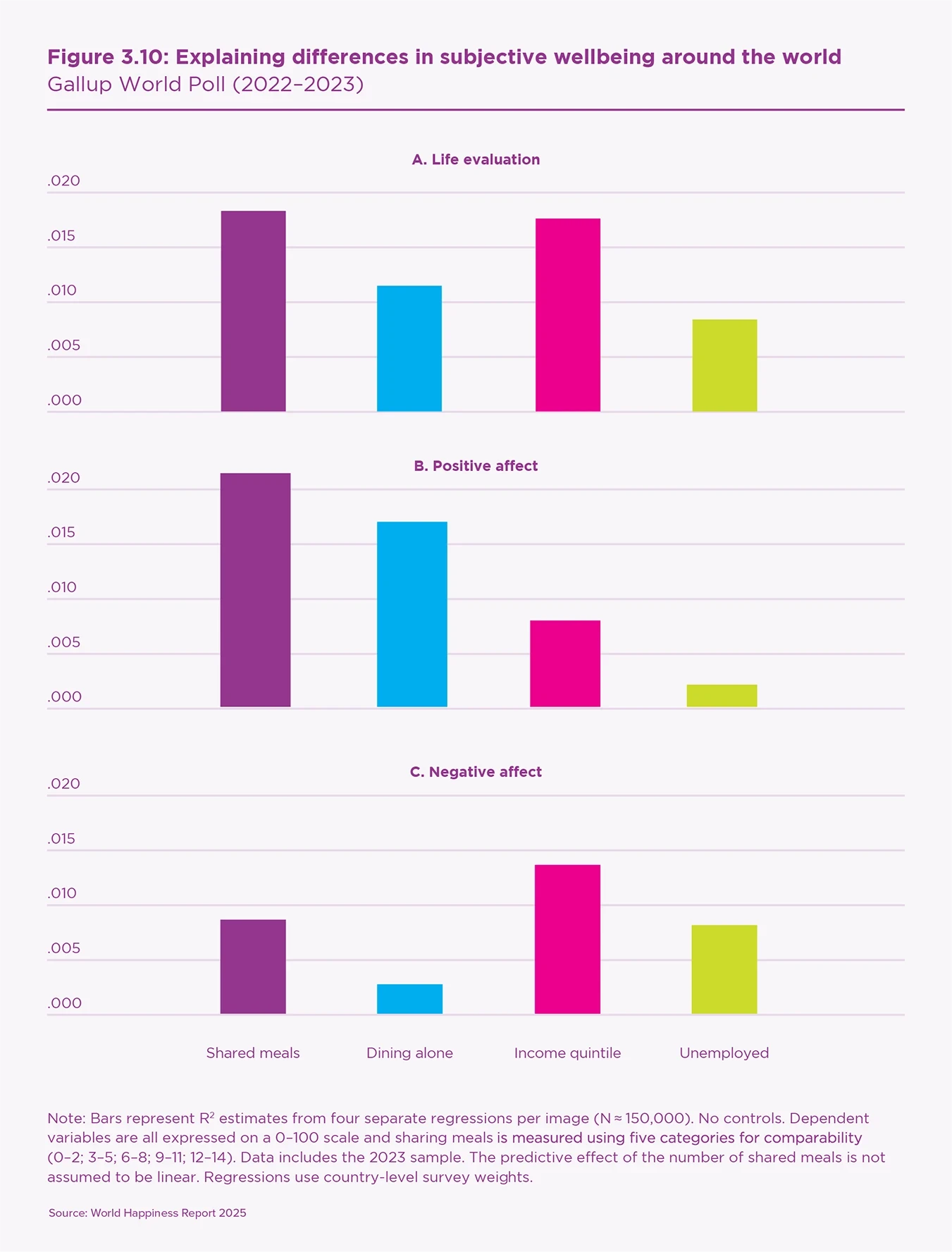
Data suggests the same. The Harvard Study of Adult Development, begun in 1938, followed hundreds of men across their lives to understand what predicts health, happiness and longevity. Its most durable finding is that warm, reliable relationships matter enormously. As Robert Waldinger put it, “The people who were the most satisfied in their relationships at age 50 were the healthiest at age 80.” The study does not say money and health habits are irrelevant. It says the good life is less private than we imagine. It is built and maintained through other people.
Rapid advances in AI will raise living standards across society. This week Dario Amodei emerged from his San Francisco warren to remind us of the potential downsides and call for action before it is too late. In Policy on the AI Exponential, he names the other side plainly: “We risk ending up in a world where the economic tradeoff dial is stuck on the hypergrowth, hyper-inequality setting.” The technology could make ordinary life materially better while concentrating ownership, power and leverage among the companies and investors that control the models, compute, data and distribution.
That is why the policy question cannot be limited to sci-fi risk or model safety. Amodei argues that governments need to prepare for labor displacement, new tax models, income support, and ways to make sure extraordinary growth does not harden into a winner-take-most system.

Today SpaceX goes public. Musk will become the world’s first trillionaire soon. I admire many of his accomplishments. I don’t want his life. And I certainly don’t want to live in Starbase, the 2D factory town that embodies his beliefs.
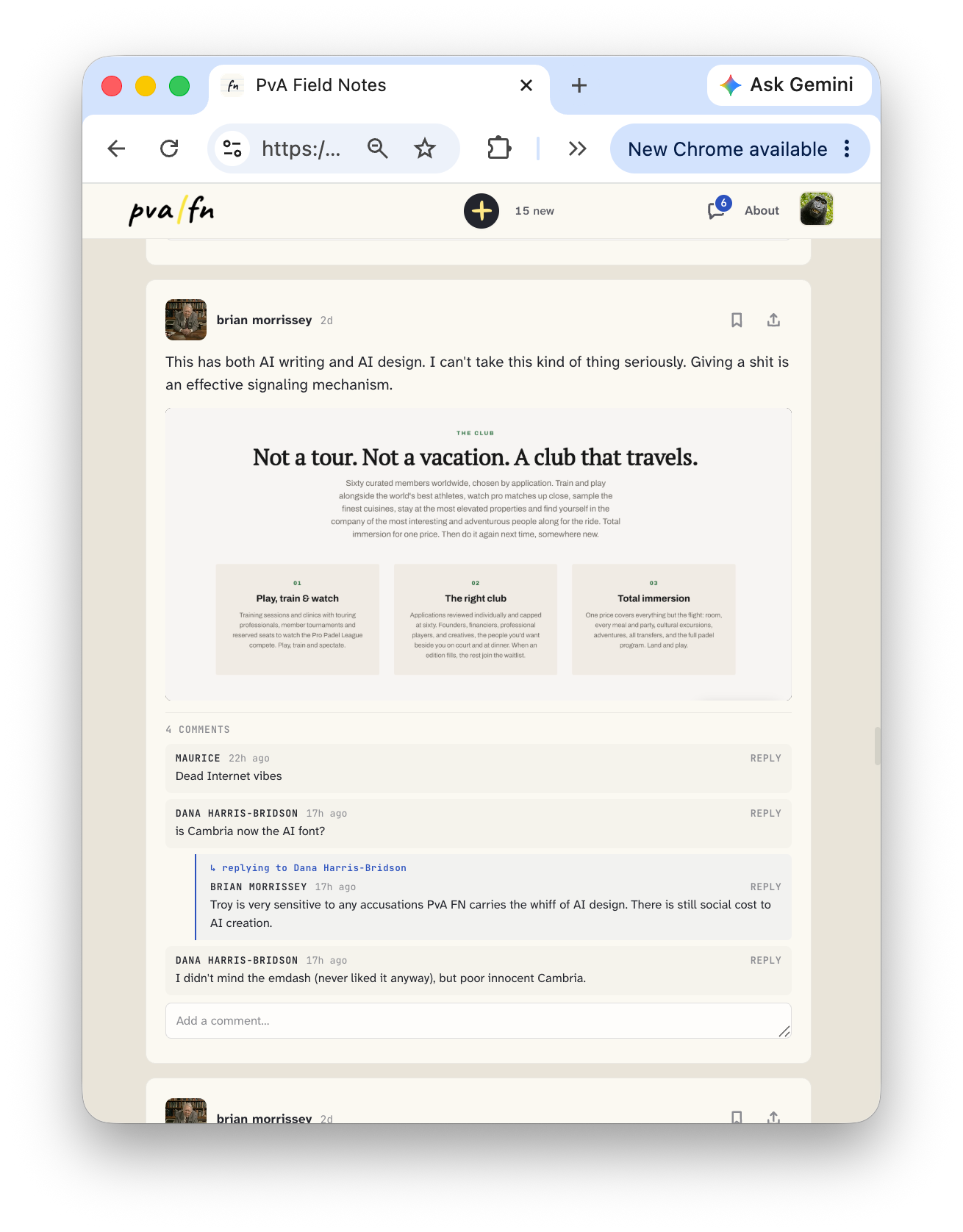
PvA Field Notes Is Live
We’ve turned the People vs Algorithms group chat into a public feed that you can SMS into. Let’s see how this goes. Check it out at https://pvanotes.com,

The Abundance Economy
Out FRIDAY 6 AM EST Apple | Spotify | Substack
We have more books, more newsletters, more songs, more apps, more everything. Seen one way, AI has democratized the creative process. Seen another, we are swimming in a sea of mediocrity that inevitably crowds out attention to human-led creativity. Plus: Handicapping Hot AI IPO Summer, YouTubers as Hollywood’s saviors, GLP-1s vs impulse manipulators and Breaker’s Lachlan Cartwright assesses the characters in the 60 Minutes drama that’s like Viagra for media newsletters. Finally, an ode to the old-standby of cocktail parties: pigs in a blanket.
FIELD NOTES

The iPhone is now being blamed for part of the fertility decline after 2007. Whether or not the studies hold up, the phone has become the cigarette of the era. » New York Times: Two New Studies Ask: Did the iPhone Cause Birthrates to Decline?
A Ukrainian drone-maker says fully autonomous drones have already killed soldiers without human approval. » New Scientist: Fully autonomous drones have killed human soldiers for the first time
SpaceX has become hard for all investors to ignore. Index rules force exposure to Musk’s space-and-satellite empire whether fund managers like the story or not. » Financial Times: Not having an opinion on SpaceX is going to cost you
Anthropic’s Fable rollout shows how much power model companies now have over other people’s work. A policy change inside one lab can instantly change what developers, researchers and companies are allowed to do. » Wall Street Journal: Anthropic’s New Fable AI Model Is Met With User Backlash Over Restrictions
OpenAI is considering token price cuts as competition with Anthropic heats up. A real test for businesses valued like monopolies but selling tools customers can swap out. » Wall Street Journal: OpenAI Considers Drastic Price Cuts, Anticipating War for Users With Anthropic
OpenAI’s confidential IPO filing puts another trillion-dollar AI company in the queue. » Wall Street Journal: OpenAI Files to Go Public in Test of Investor Appetite for Top AI Startups
Google renting xAI compute capacity from SpaceX turns Musk’s companies into an AI infrastructure trade. If Grok is not the winning product, selling the shovel may be the better business. » CNBC: Google to pay SpaceX $920 million a month for compute capacity at xAI data centers

AI companies are giving Manhattan landlords their best market in years. The dot-com comparison is obvious. This time the tenants arrive with deeper pockets. » Wall Street Journal: Manhattan’s Red-Hot Office Market Poised for Its Best Year Since 2000
Apple is marketing Apple Intelligence as the cautious option. Its pitch is privacy, on-device processing and fewer promises about digital gods. » MacRumors: Apple Reveals New AI Architecture Built Around Google Gemini Models
AI writing drives real writers nuts. Sam wants to kill for it. » Sam Kriss: If you let AI do your writing, I will come to your house and kill you
The Economist told internship applicants not to use AI to write or refine their submissions. Writing counts as evidence of thought. » The Economist: The Economist’s culture internship
The Granta controversy shows how quickly AI suspicion now attaches to polished prose. Writers are entering a strange period where sounding too smooth can become its own problem. » The New Yorker: A Commonwealth Prize-winning short story, recently published in Granta...
The fake Adele-and-John-Legend duet in an Uber is a useful snapshot of where mass culture is headed. Synthetic media does not need to fool everyone; it needs enough people not to object. » PvA Field Notes: Another Uber. Another driver playing video while driving.
Backrooms is a good sign for theaters and a bad sign for tired IP. A young creator with a strange internet-native idea made the multiplex feel less dead. » New York Magazine: If you spend a lot of time on YouTube, you may have come across ‘The...
CAA’s creator rollup is another sign that Hollywood is chasing the audience downstream. The talent agencies want structure around creators who already proved they can gather a crowd. » Hollywood Reporter: CAA and Integrated Media Launch Creator Economy Rollup Compound
The new Social Network movie has to deal with a very different Zuck. » YouTube: THE SOCIAL RECKONING – Official Teaser Trailer
GLP-1s may end up mattering far beyond weight loss. If the drugs reduce craving, they threaten a lot of businesses built around people doing a little more than they planned. » Good Morning America: Doctor breaks down study showing GLP-1s may lower breast cancer risk
San Francisco’s rejected billionaire tax still points to a bigger fight. Cities are trying to find new ways to tax wealth in a world where labor is easier to reach than capital. » New York Times: San Francisco Voters Appear to Reject Tax Hike on Highly Paid C.E.O.s
Kalshi’s influencer mess shows how political gambling can reward the worst kind of attention. If doubt drives betting volume, civic trust becomes just another acquisition cost. » Semafor: Kalshi asks paid influencers to delete posts sowing doubts over LA mayoral election
Founders Fund making a Mafia show is a good example of tech media becoming comms infrastructure. It is entertainment, recruiting, mythology and positioning in one package. » YouTube: Can Tech Legends Find the Liar? (Mafia Episode 1)
Nick Bilton at 60 Minutes is a strange collision of media eras. A digital-native storyteller is now inside one of the last great broadcast institutions, and the institution is not taking it quietly. » The Nation: What’s Behind the Corporate Pillaging of “60 Minutes”
Pamela Drucker Mann wants to build a business around short fiction. It is interesting bet that literary work can be packaged with modern sales discipline without losing its reason to exist. » Wall Street Journal: She Ran Sales at Condé Nast. Now She Plans to Monetize the Humble Short Story.
BYD’s five-minute charging push in Europe is a direct challenge to legacy automakers. The old brands still have prestige; the Chinese companies are attacking the practical problem. » Financial Times: BYD to spend €2bn to build out 5-minute flash chargers in Europe
College kids running OnlyFans bot farms is the underground attention economy in miniature. It is affiliate marketing with fake intimacy and a better margin. » PvA Field Notes: Had lunch with a TRB Capital portfolio company founder
GOOD PRODUCT
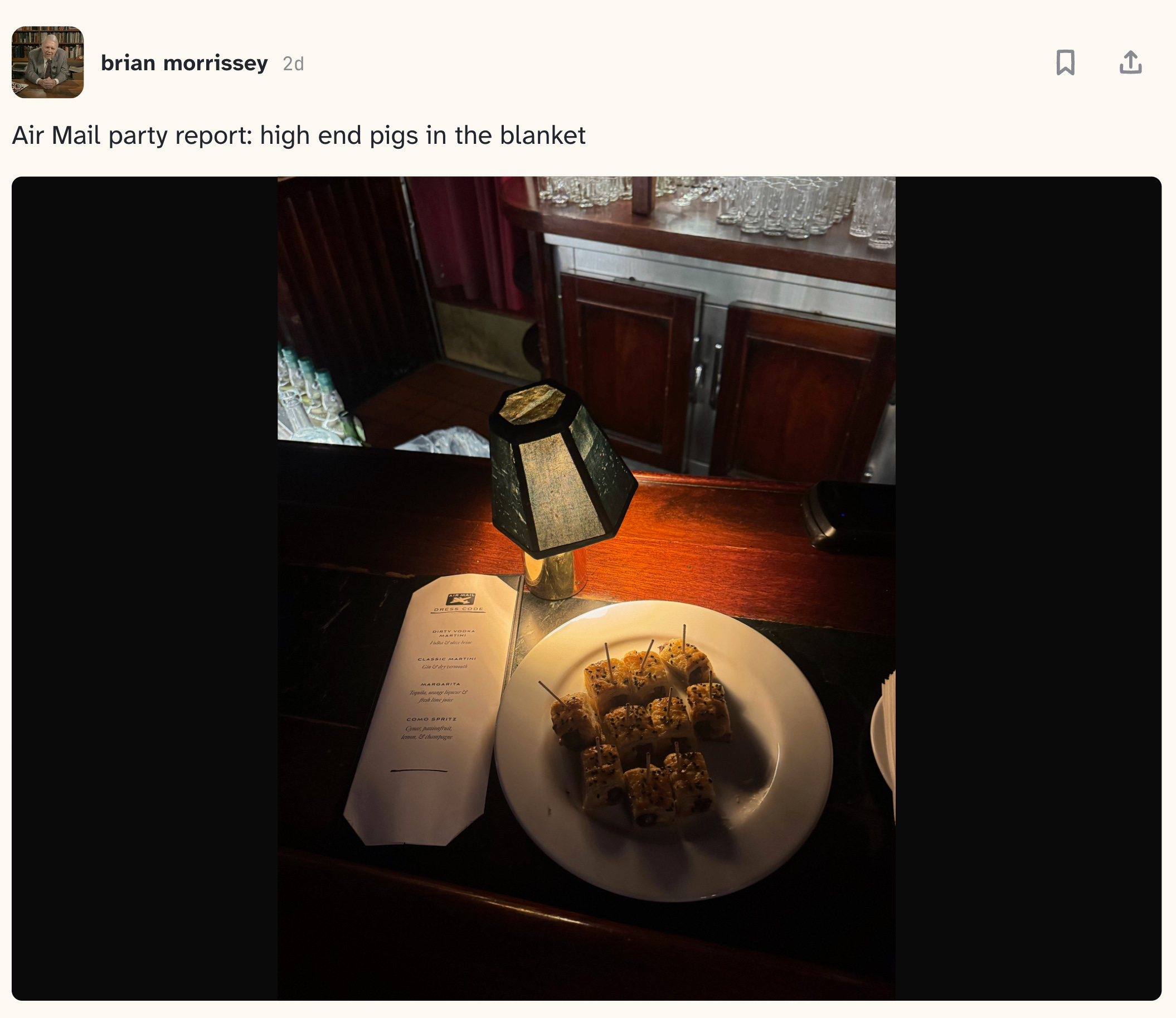
Pigs in a blanket are perfect cocktail food because they do not ask to be taken seriously. Our other favorites? Bacon-wrapped dates, tuna tartare on chips, cocktail samosas, lamb lollipops, warm arancini. Less loved: mini sliders,. tea sandwiches, endive boats with blue cheese and walnuts, blini with smoked salmon and crème fraîche, mini crab cakes.
What are yours?
Send your feedback. Love hearing from you.