

Emily Sundberg, New Media Energy and Hot Takes
Emily joins to help us understand stuff. Plus Troy's next coding experiment is live.


Good morning.
Emily Sundberg joined the podcast this week and it was supersonic.
Just after the recording we learned OpenAI acquired TBPN. Sam Altman professed his affection for the duo on X:
TBPN is my favorite tech show. We want them to keep that going and for them to do what they do so well… I don’t expect them to go any easier on us, am sure I’ll do my part to help enable that with occasional stupid decisions.
Naturally, we had to quickly light the mics back up and comment. Emily could not resist sending over this tweet from Rat King. I hope Anthropic gives her a bunch of cash too.

Let’s leave that to marinate.
I could not help talking about my new AI coding exploits on the pod. Combining product strategy with design and coding in a one man do-it-yourself to and froh is soooo addictive. Way more than social media ever was for me. Downside… it may be making me even more impatient with real humans. Working on this.
For now, I’ve finished with the PIMP app (Personal Intelligence Media Platform) that we spoke about last week . I use PIMP every day and it might be making me a more efficient media consumer. I dunno. BTW, my daughter continues to make incredible progress on her film investment ROI app - AI coding has become a lively family affair.
PIMP did spawn a fun offshoot project. I wanted an app that combined note taking — registering ideas or “takes” that occur to me now and then — with a little research agent. What came out was the Hot Take Machine. I probably need to work on the name and brand. It’s fine for now.
Think of Hot Take (hottake.peoplevsalgorithms.com) as Twitter for “takes.” Except here the machine helps flesh out your argument.
Here are some screen shots. Give it a try. Let me know what you think.


How it works:
The feed is a list of “takes” made by users. The “take” is just an idea you have about the world. Any claim.
Click the big pink button to add a “take” — it can be a line of text, a voice recording, a URL, a screenshot. A carefully conceived or a half-baked idea. The AI builds the strongest possible case for it: the sharpest thesis, most convincing evidence and supporting facts.
Click “cold shower” for the opposite view. Hit “PvA take” to get the “official” POV based on hundreds of pod transcripts and newsletters. I might add different “takes” over time from people that let me do it. TBD on value of this.
You can also challenge anybody else’s take.
Every hot take gets a conviction score from 0–100. How well does the argument actually hold up?
Each week, takes from our podcast show up as colored grouped list in the feed.
The rest are ordered by recency and topic. The feed is like a live debate board.
I’ve included Google Auth so people aren’t assholes and names are attached to takes. But you can go in anonymously if you want for now.
The cost: The problem with these AI apps is they are token hungry. I’ve spent about $300 in tokens building stuff over the past few days, significantly more than I spend on streaming services. Admittedly it’s a fraction of what it would have cost to have a real team build stuff in before times.
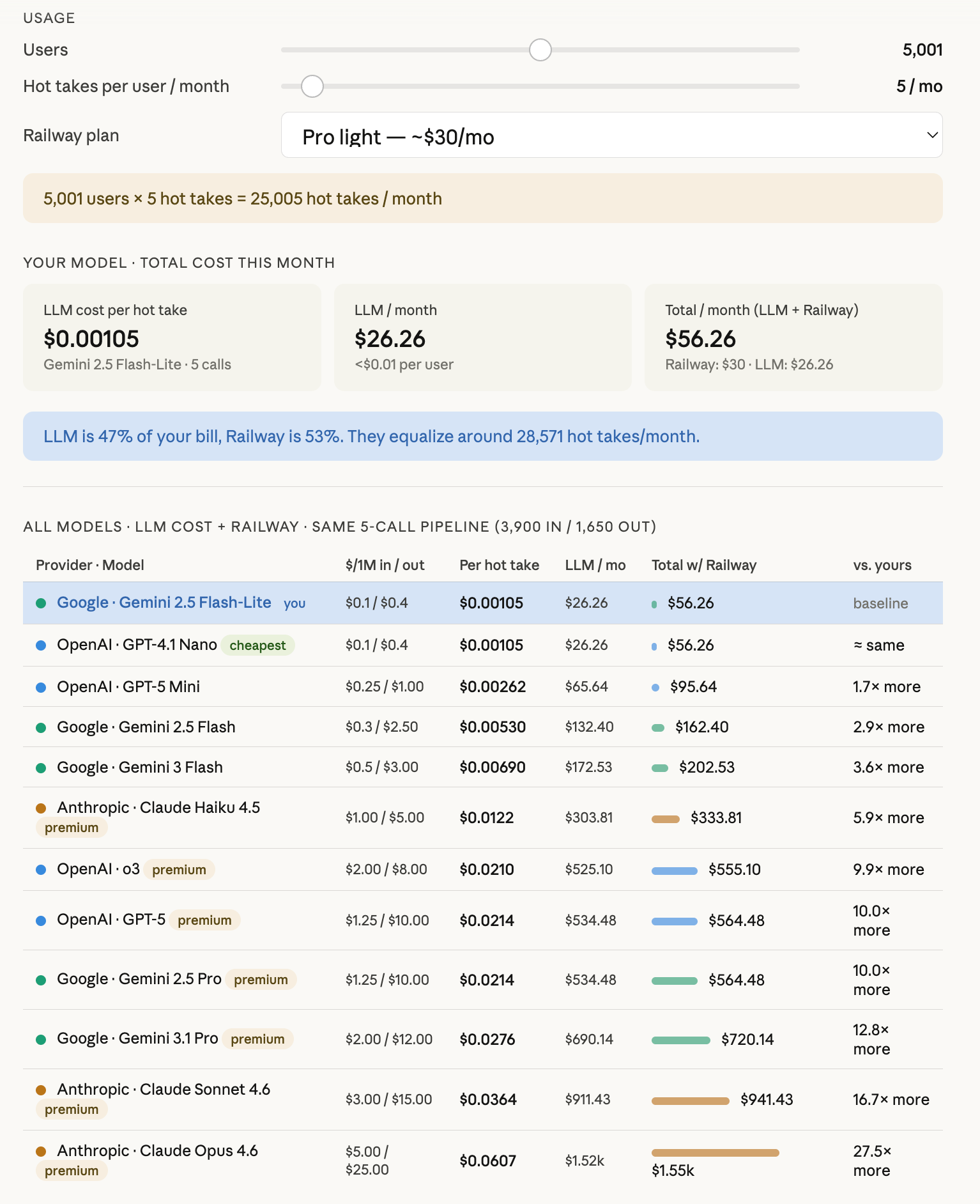
But the problem isn’t the cost to build. Go forbid a lot of people use it. I made a calculator to see what would happen. If 5000 people use it 5x per month, it will cost a manageable $50/month, provided I route most of my requests to the inexpensive Gemini 2.5 Flash model. If I used Claude Opus the costs would be $1500/month, 30x as much. If a million people used the existing model it would chew through more than $5000 / month of the cheap tokens. Anybody who builds stuff like this will have to work hard on token efficiency and the pull toward free open source models will be strong.
Why do this? These projects are a great way for me to understand how AI is gonna change how we work, how orgs are optimized, how value is sustained, where moats might emerge. An obvious question is is why create a tool that is just replicating a conversion you might have with a chat bot? Other than formatting the prompts and structuring the result, capturing the a feed of what the community is asking is obvious answer. Maybe it can turn prompts into human back and forth. I’m not sure. The question of how value is created on top of LLMs will be asked frequently as we absorb this technology.

Pod 178: New Media Energy
Out FRIDAY 6 AM EST Apple | Spotify | Substack
Troy and Brian react to OpenAI buying TBPN: It pays to have viewpoints and approaches that are preferred by the powerful. FeedMe’s Emily Sundberg joins as a guest this week. We discuss why new media like TBPN is beating legacy media not by distribution hacks or aesthetics but in energy. Legacy media relies on structural energy that’s dissipated while new media is built on earned energy, which is more organic, relatable and even fun. Plus: Puck vs Vanity Fair, Troy’s vibe coding addiction, and why venture capital isn’t cool.
Maybe AI chatbots can undo some of the harms of social media. FT’s John Burn-Murdock explains. Paywall article here.
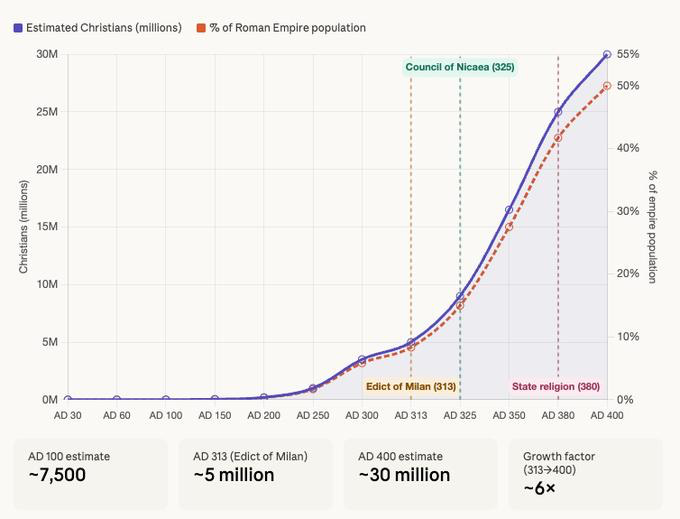
Chart of the day: AI-driven Mac Mini sales or how Christianity went from a tiny minority to the dominant religion of the Roman Empire:
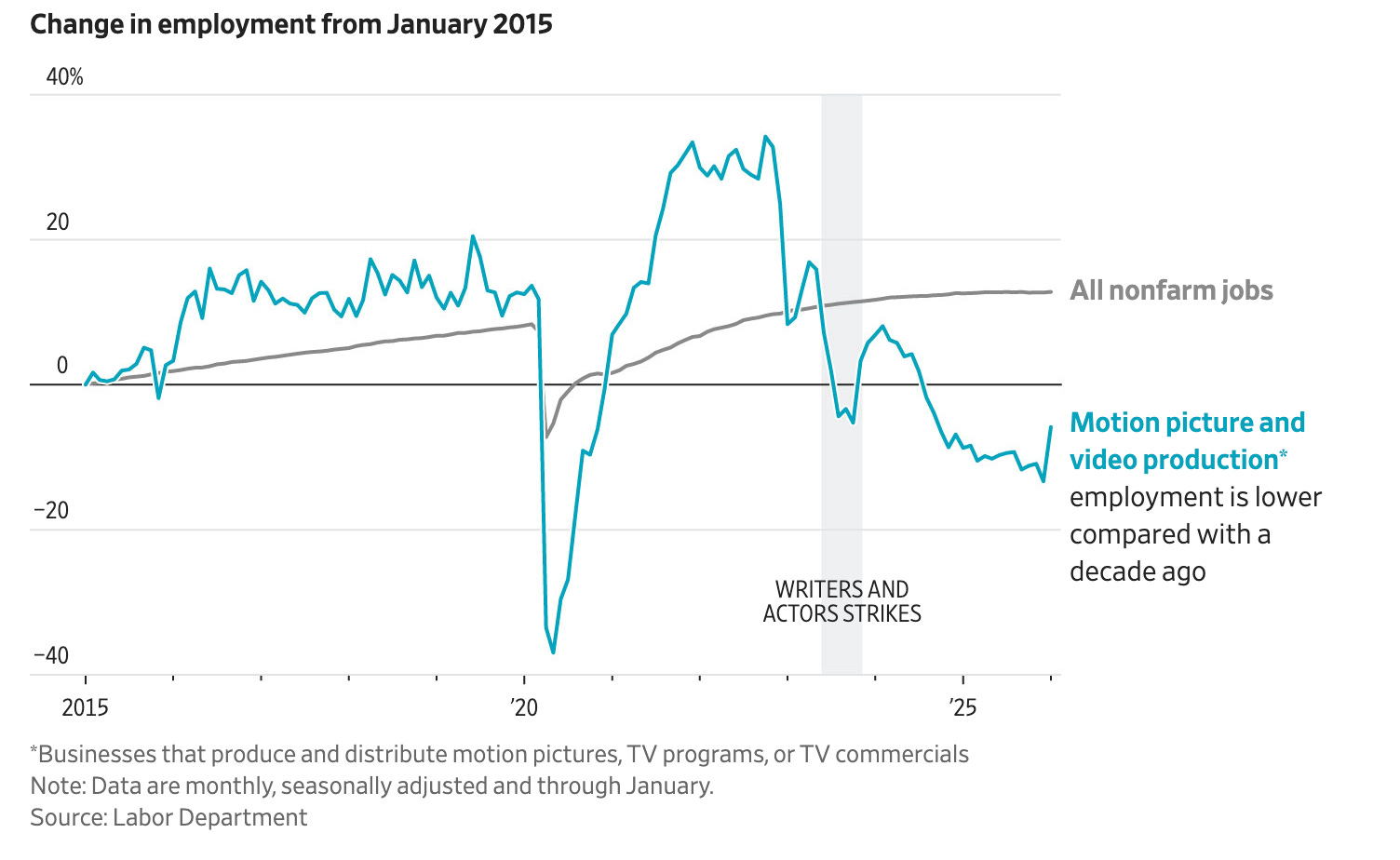
And one more. Hollywood job market is collapsing:

A Monumentally Hideous Skyscraper “Library”
Donald Trump’s reveal of his Miami-based presidential library—a 50-story skyscraper featuring a golden statue and a Qatari-gifted Boeing 787—has sparked a predictable firestorm. While the President frames the tower as a “lasting testament” to his legacy, critics like Robert Lamondin Jr. are ranting about the “weird” scale and the controversial donation of public land by Miami Dade College.
The Experience Arbitrage
Red Seat Ventures—the creator incubator acquired by Fox—is launching a premium membership for the ultra-wealthy. It’s a strategic pivot from mass-market digital content to high-end hospitality and exclusive live experiences. In an age of infinite digital slop, Red Seat is betting that real-world access is the only remaining scarcity worth a premium.
Talent Management as the New Ad Sales
The power shift from institutions to individuals means “wrangling talent” is now more critical than selling ad slots. Even legacy giants like The New York Times are hiring video coaches and producers to transform traditional journalists into “hosts.” Personality-driven journalism is no longer a niche—it’s the new baseline for engagement.
The TBPN Effect
Technology Business Programming Network (TBPN) is proof that media success today is about "earned energy" rather than massive subscriber counts. By live-streaming for three hours a day, they’ve built a business that works even when only 100 people are watching a feed covered in ads. Emily highlighted their recent "peptide debate" between Martin Shkreli and Superpower tele-health founder as a perfect example of their mischief and playfulness. It is a level of fun that legacy brands struggle to manufacture.
The Guano Trade and the Spirit of Enterprise
Brian takes us back to the mid-19th-century Guano Islands rush to show that the spirit of enterprise hit different before the age of AI tokens. While we are currently vibe coding our way through digital productivity, the 19th-century version was a high-stakes physical hustle that laid the groundwork for modern trade. It raises a question for the digital age: Are we moving toward a post-Gutenberg oral culture where the ability to think and communicate on your feet is the ultimate competitive advantage?
Cool or Not
We put FeedMe’s Emily through a round of “Cool or Not Cool” to calibrate the zeitgeist: Venture Capital: Not cool. “Too much money and too few good ideas.” Home Saunas: Not cool. It’s about leaving your house and using someone else’s towels. Catholicism: “I think like as the world becomes more complicated and digitized and people are spending eight hours building like tools of AI, I think people turn to all kinds of things and whether that’s like a sauna or a church, I think that uptick of like searching for self care and meaning is real. I don’t know if people are necessarily actually becoming more religious... I think it’s definitely aesthetic.”
GOOD PRODUCT
Music: This week we appreciated the soulful vocals of Olivia Dean and Flea’s unexpected jazz-infused debut album, Honora, where he trades the bass for a trumpet. We love late career innovation from Flea.

TV: HBO’s DTF St. Louis, a nonlinear black comedy featuring nuanced performances from the incredibly talented cast… Jason Bateman, David Harbour, Linda Cardellini, Richard Jenkins and Joy Sunday deliver an inspired script beautifully.