


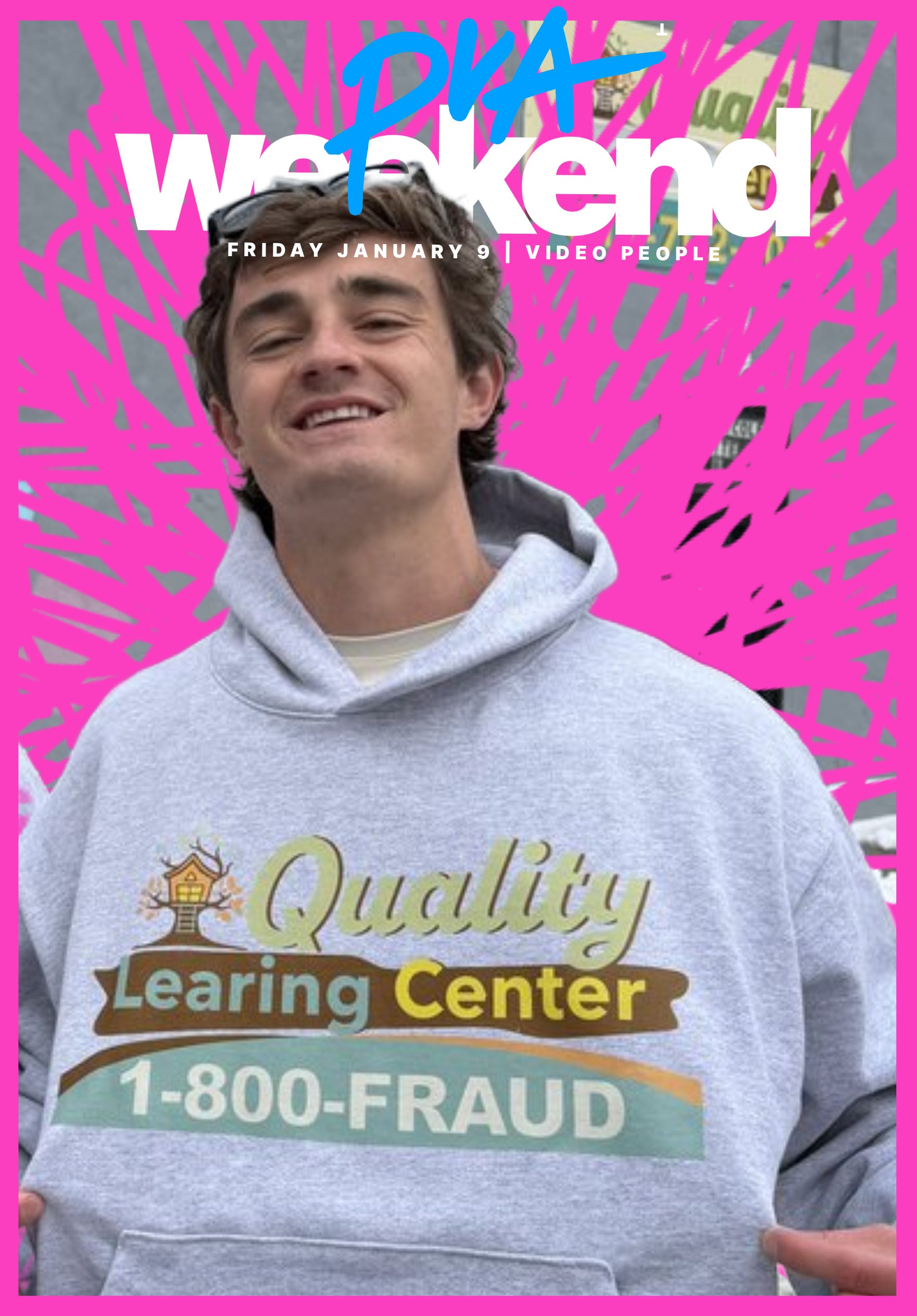
POD 166: Finding Leverage
From CES to YouTube to legacy media’s slow unwind, this episode is about where leverage actually lives now. Troy and Brian talk about agentic advertising and why it’s being sold as salvation, the quiet consolidation happening across media and tech, and the shift from institutional power to systems, platforms, and legible individuals. We discuss sovereignty in an automated world, and why “finding leverage” has become the defining challenge for media, marketing, and anyone trying to stay relevant.
Out FRIDAY AM Apple | Spotify | Substack
Troy: Regrettably, we landed on the term “influencer.”
The logic was straightforward enough: these were new-fangled participants outside the media complex who shaped tastes and opinions. More importantly, they influenced commercial outcomes. That’s what advertisers wanted. The term stuck.
For real media types, surely the term is better in its adjective form than noun. Fill in the blank: you are an influential ______.
The term “creator” emerged to add some dignity, though it feels equally hollow—somewhere between God and Tyler. It too lacked the je ne sais quoi of a real “Media Person.”
I start here because it’s a new year and I read all the predictions, and I kept coming back to the idea that 2025 was the final dying year of an old institutional media system. And I kept thinking about YouTube—partly because I love it and partly because I wonder what it tells us about our media condition that people spend more time there than on any other streaming service. YouTube has become the final disruptor as media completes its 20-year migration to the internet’s demand-driven construct.
The people making things here are certainly not influencers, at least not in the way that term has come to mean. Influencers traditionally congregated on more superficial networks.
Certainly, they “make,” but the creator label feels lazy. They are many things. Experts and enthusiasts. A new generation of self-professionalized producers. Mini show runners. Amateur documentarians. B2B big mouths. Content marketers with something real to say—which I have no issue with when the content extends elegantly from self-interest. Newfangled news sleuths. The funny people. A fair amount of traditional media crossover live here too, now algorithm-filtered and right-sized.
They’re the Adam Savages, the Marques Brownlees, the Patrick O’Shaughnessys. The VC hustlers you love to hate. Savage Geese and an army of similarly obsessed car guys. Media brands that learned how to translate—NYT, Eater, AD. The guy who shows you how to fix your espresso machine. Nostalgia-fueled snippets from Conan, Carson, SNL that simply surface when they should. Goofy celebrity formats from Criterion. Savvy content marketers like Huckberry. Amy Poehler is a Good Hang. Pablo Torre finds out! Insufferable stereo nerds. NFL recaps. Look! Timothée Chalamet is everywhere.
What do we call these people—the ones making the media I actually want to watch? “Media people” implies some journalistic élan that doesn’t fit. “Video people” sounds diminutive. “Content producers” will do for now, though it misses something essential. These are people held together by networks and algorithms, not media brands and institutions. Their virtue is an elegant expression of their professions, hobbies, expertise, passions, and neuroses—which might be the highest expression of humanity. They are People Making Media, not Media People. They do it for love. And money.
2025 was the year they came for your TV set. The living room is now their surface. YouTube collapsed short and long, lean-back and lean-forward, amateur and professional. This marks the end of network-era programming, replaced by algorithmically-driven expertise.
One stat stuck with me: despite significant subscriber growth, Disney’s streaming engagement has flatlined. According to Nielsen, the combined streaming share of Disney+ and Hulu has hovered in the high four-percent range for years. In the long run, engagement is the coin of the realm. YouTube’s is 3x that in the US and 10x globally. More importantly, streamers’ cost curves are upside down. Professional content is too expensive to feed the algorithms. Streamers don’t just have a cost problem—they have a scale problem, an IP problem, and an engagement problem. They have a platform problem.
Netflix, big, profitable, and technically sophisticated, comes closest to solving this. Apple and Amazon accessorize with content for now. AI only strengthens platform dynamics: more creators with better tools, more diversity, more content, better algorithms, and a stronger decentralized marketplace. In the end, streaming begins to resemble digital media more broadly: fragmented attention, infinite choice, weak loyalty outside a shrinking pool of franchises. Loading interfaces with ever-more expensive premium content looks increasingly ominous.
2026 is when the industry confronts this reality. The space between being an accessory for Apple or Amazon and being a true platform is shrinking fast. Streamers face both engagement and economic crises. The survivors will navigate the same forces that shaped digital media:
Creator marketplaces suffocate old media structures;
Technically sophisticated platforms win by serving consumers better;
Sophisticated ad systems demand massive investment and are a huge moat for winners;
Lean, talent-first cost structures win;
Messy experts beat polished pros;
Strong community fortifies the best brands;
Related… interactivity and utility alway creates engagement and habit;
Media is easier when supported by diversified revenue across experiences, commerce, and hardware;
Live content, particularly sports, is the final differentiator but increasingly out of reach for all but diversified tech giants.
Against that backdrop, a few things seem likely in ‘26:
Netflix wins on scale, interface and product, not just programming—and slowly opens to contributors. They begin a platform evolution.
CBS News is wasted energy: A herculean and commendable effort, but Bari Weiss gets an ulcer trying to fix a dying, irrelevant franchise. Her focus should be super-charging 60 Minutes across channels and formats to reach new generations and building depth to the Free Press’s impressive two million subscriber base by leveraging the dying embers of the CBS machine.
News increasingly comes from unexpected sources like Nick Shirley, the 23-year-old whose Minnesota fraud investigation drew 3.3 million YouTube views.
Disney elevates the Parks guy. Josh D’Amaro wins over Dana’s legacy content leadership.
Paramount stumbles without scale, platform, or IP leadership. Losing Warner means scrambling for Plan B—potentially involving Apple, Amazon, Main Street Sports, or unexpected NBC reconfigurations.
Podcasts thrive; few win the video crossover game of becoming talk shows. Netflix’s foray here will struggle. YouTube wins here.
Publishers with subscription scale driven by reporting and quality prosper as the market for quality narrows. A back-to-the-future story. Most of the rest gets sold, rationalized, and reinterpreted as harvestable IP, not media.
Indie creators thrive as small businesses, community leaders… the main characters in a platform landscape.
Related… everyone has an agenda. In the Information Space there is no “objectivity” or at least the illusion of it evaporates. Like it or not, your job is to sort through competing perspectives. This is normal now.
Finally, media keeps getting weirder, if that is possible in the Trump era. Media is now as weird as people are weird because… the media is just us. Call it the Lizza-Nuzzi factor.
Bonus… traditional search doesn’t disappear. We are watching it bifurcate. Old search is navigation… AI chat is interactive question answering (and obviously a whole lot more). We will need search-as-navigation for a long while.
The bottom line is this: 2026 is the inflection point when we stop thinking about hallowed media companies as trusted institutions that make content. Media power now resides in systems, interfaces, and legions who create against the most fundamental human incentive system: we are… so we make.
Platforms stole media’s mantle and taught us that the media is the people. Then everything became video. In 2026, that same force redefines how we think about all media.
Video is us too.
Brian brought an excellent list of “2026 Superlatives” to the Pod this week. Here they are:
End of an era moment: BuzzFeed’s end of the road.
BuzzFeed is valued at $35m. It will be scooped up by a PE chop-shop.
Unlikely comeback of the year: Portals.
Yahoo in particular will go public and show that the open web ain’t dead. Portals are well positioned in the open G of the AIpocalypse.
Most Unlikely Culture War: The Pope vs AI and MAGA.
A strange realignment year where moral authority, machine intelligence, and populist politics collide. Less theology than legitimacy. More about who gets to speak for meaning in an automated age.
Information Space Main Characters: Indie investigative reporting.
Nick Shirley, Pablo Torre and even James O’Keefe are part of a growing class of independent investigative journalists who often have skin in the game or an ideological axe to grind.
Most deployed AI marketer buzzword: Agentic.
Do not hold your breath for AI to book your next vacation or even execute a simple ad campaign.
Premature death: New York and San Francisco.
Declared finished again. Somehow still where the talent, ambition, and weirdness cluster when things actually matter.
Most Anticipated Disaster That Never Came: The Jobspocalypse.
Plenty of disruption. Very little apocalypse. The story shifts from mass unemployment to uneven adaptation and quiet role mutation.
Elite moral panic: Prediction Markets and Gambling.
What starts as information aggregation ends as a cultural fight about speculation, incentives, and who is allowed to profit from uncertainty.
Longest Running Fight With No Resolution: The Battle for Sovereignty.
Publishers, creators, governments, platforms, and users all trying to claw back control from systems that reward scale and opacity. No winner yet. Stakes rising.
Word of the Year: Legibility.
Not attention. Not reach. Being understandable, trustworthy, and durable to both humans and machines. The people and businesses that win are the ones that can be clearly seen without shouting.