


Good morning one hit wonders…
There’s a song you have probably heard a million times. You may have heard it at a wedding. While you may have no clue who sings this song, 90% of you will respond favorably when you hear it. The rest of you probably kick dogs and hate babies.
Go ahead. Try it. It is that kind of song. I love it. I can listen to it 1000 times. I am not ashamed.
I discovered something else about this song. It's a '90s DJ in a box. An algorithmic dog whistle, overflowing with the sweet sound of upbeat nostalgia. An undercover playlist masquerading as a song.
It’s the reason why machine generated playlists are so good, even if they are short on the human je ne sais quoi that makes all AI interactions feel kinda wooden and predictable.
Here’s the reason. “You Get What You Give” sits at the intersection of several late-90s musical “vectors” that Spotify-style systems love to cluster together:
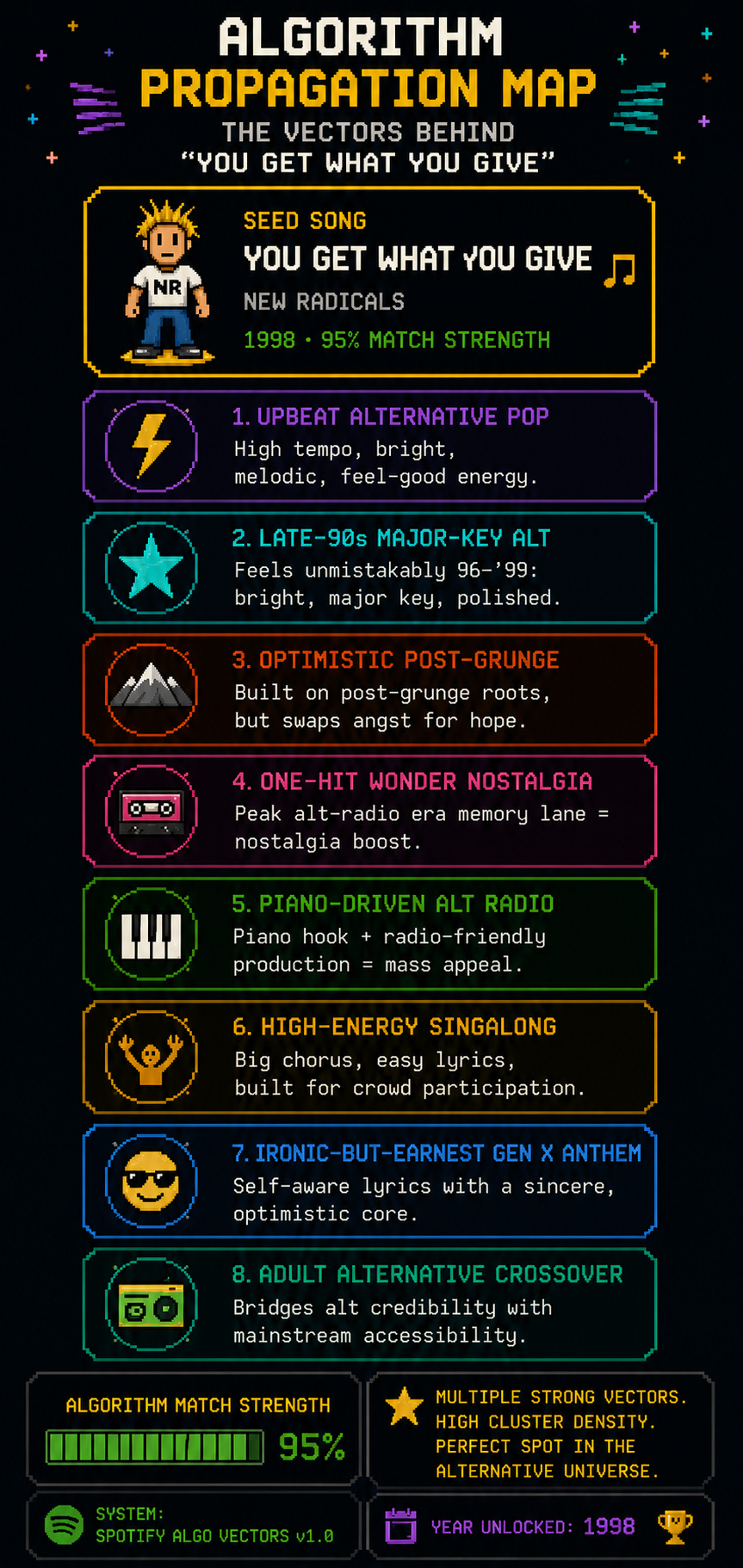
Recommendation systems do not think in genres the way record stores did. They think in behavioral and sonic similarity clusters. The song has a weirdly broad profile:
Earnest self-help-ish lyrical energy
Crunchy alt guitars, bright piano
Huge melodic chorus
Funk-pop groove underneath
Polished Max Martin-era loudness
BPM that works for driving/workout/background listening
Emotionally uplifting despite “alternative” branding
That makes it unusually “connective” inside recommendation graphs. So the algo discovers a hidden category humans didn’t formally name: “late-’90s upbeat ironic optimism before the internet got dark.” Suddenly, without any additional signal you are in a vibe stream, for better or worse.
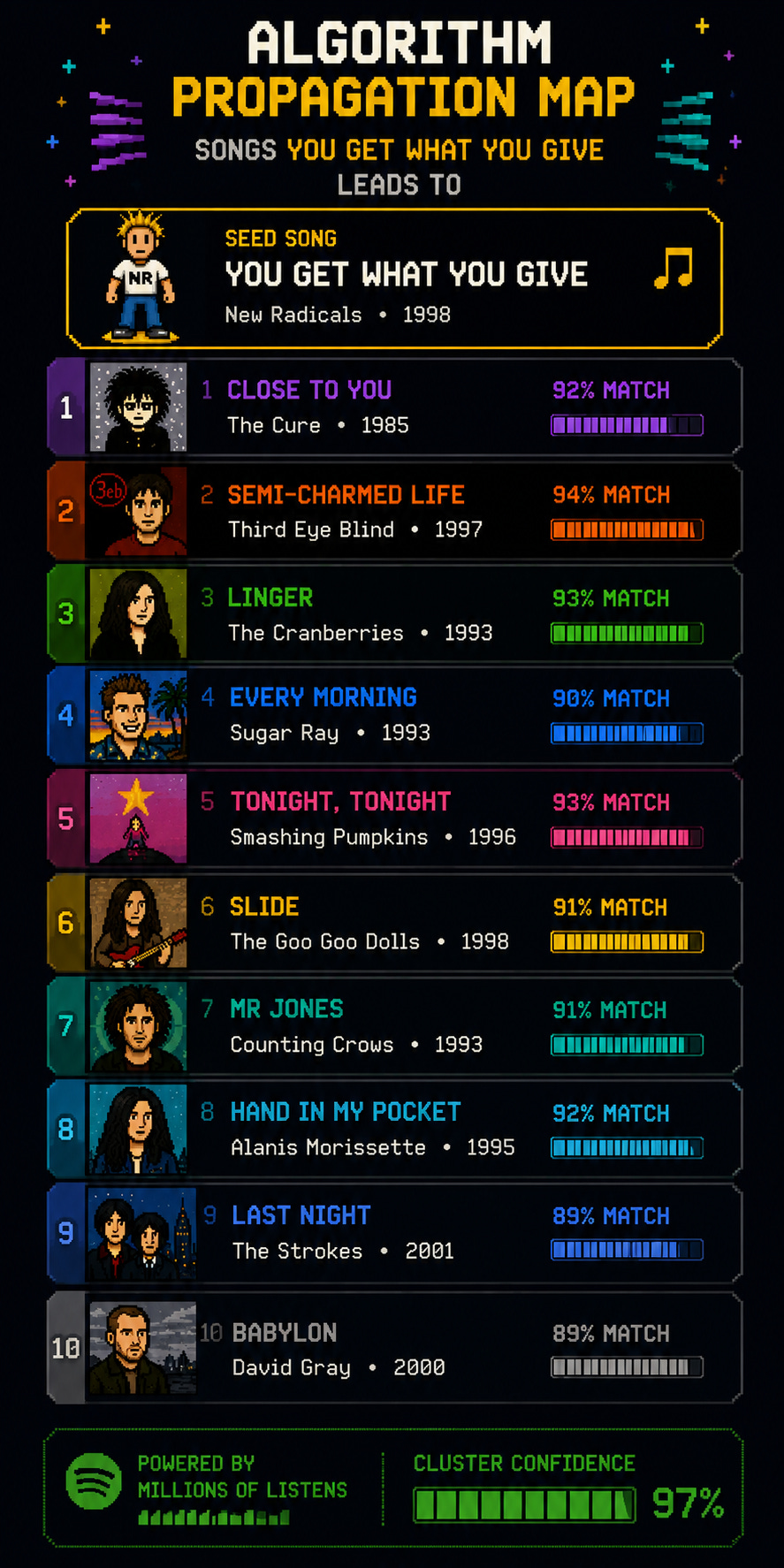
The stream is not operating on strict genre logic. It’s operating on a blended nostalgia-and-emotional-continuity logic. Maybe the Strokes “Last Night” is odd man out here. But the algo does its darnedest to mix it up a bit.
There’s also another subtle factor: the song has extremely strong “opening seconds.” Algos heavily reward tracks with low early-skip rates. You Get What You Give opens immediately with momentum and clarity. No long intro, no ambiguity, no set-up
In a way, Spotify retroactively redefined the song. What was once perceived as quirky alt-pop became part of a optimized nostalgia-energy graph. That’s one reason so many people feel trapped in these “algorithmic rivers” where one song leads to a whole ecosystem of adjacent emotional textures from a specific era.
Gregg Alexander, the singer and creative force behind You Get What You Give, walked away from fame almost immediately after the band’s massive success because he hated celebrity and touring, then spent years quietly writing and producing hits behind the scenes. Over time he re-emerged as a cult figure among musicians and pop obsessives, as people realized just how much of the late-90s and early-2000s melodic pop sound had his fingerprints all over it.
The algorithmic world can deliver easy pleasure, if not the rich sensory whimsy of an actual human DJ. A microcosm of our times.
Pod 182: Monkey Business
Out FRIDAY 6 AM EST Apple | Spotify | Substack
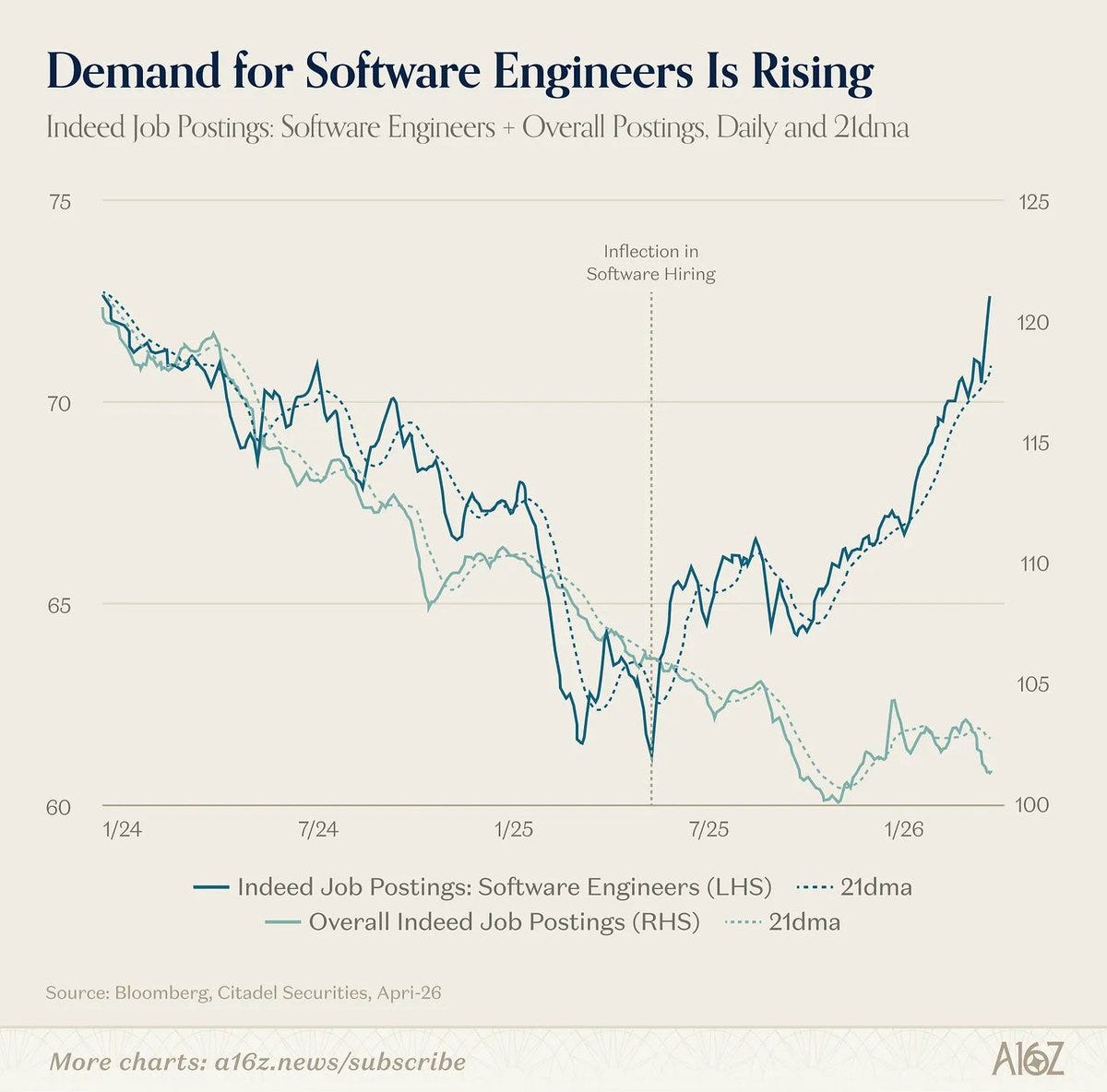
Tech companies continue to cut people and message that they’re building AI-native organizations. While some of this is cover for overhiring during the ZIRP era, there’s clearly a move to cut the “coordination tax” that exists within companies. And what starts in tech always moves downstream. Plus: Ted Turner and the end of the media mogul archetype, James Murdoch’s move to buy Vox Media’s podcast network and New York magazine, and how to tell fake fakes from real fakes at the souk.
New jobs or fewer jobs?
David George argues that the AI “permanent underclass” panic is basically a modern version of the old lump-of-labor fallacy, the recurring belief that technology destroys a fixed number of jobs instead of reshaping the economy and creating new forms of work. His broader point is that AI will likely redistribute value and power unevenly, but history suggests technological revolutions tend to create new industries, roles and demand rather than simply locking society into mass permanent unemployment.
MEANWHILE…
The Player-Coach Purge
Coinbase cut roughly 14% of staff while CEO Brian Armstrong said the company needed to become “lean, fast, and AI-native.” The message coming out of tech right now is pretty clear: fewer coordinators, fewer pure managers, more “player-coaches” using AI to compress work. 🔗 Coinbase Boss Fires 700 Workers in AI Push
Middle Management Enters the Danger Zone
AI isn’t coming equally for every job. Increasingly it looks aimed straight at the people whose primary role is translating, routing, summarizing and coordinating work between other people. 🔗 Middle Managers Are on the Chopping Block Thanks to AI, Corporate Layoffs Are Down 10% This Year, but the AI Reckoning Has Come for Tech
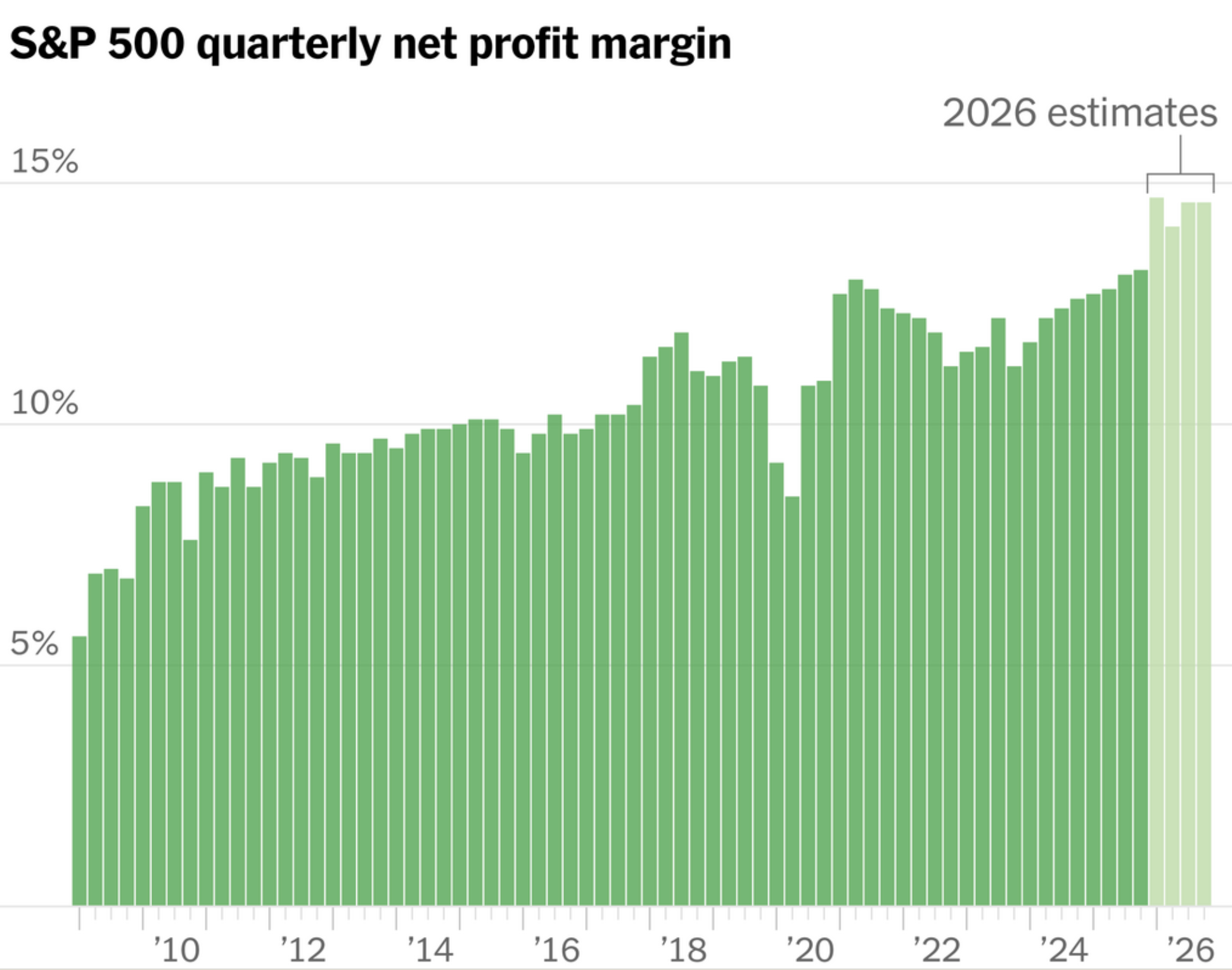
AI Is Becoming a Margin Expansion Story
Wall Street increasingly hears “AI” and translates it into one word: efficiency. The next big AI wave may not be model companies themselves, but private equity firms buying labor-heavy businesses and stripping out coordination costs. 🔗 Long Lake agrees to acquire American Express Global Business Travel
The Missing First Rung
AI is excellent at absorbing junior white-collar work: summaries, deck prep, analysis, reporting and coordination. The problem is those repetitive tasks were also how people learned the business — which raises an uncomfortable question: if AI eats the grunt work, where do future senior people come from? 🔗 AI Threatens Big Law’s Talent Pipeline
Claude Is Becoming the Company
Anthropic employees reportedly use Claude in around 60% of their work. The interesting shift isn’t that AI is a tool inside the company — it’s that the company increasingly seems organized around the AI itself.
Anthropic’s “constitution” for Claude is an early glimpse of something new: companies encoding values, behaviors and decision-making directly into AI systems. Culture may increasingly live inside prompts, permissions and model behavior instead of employee handbooks. 🔗 How AI Is Transforming Work at Anthropic
Block Gives Us Their Agent
Block, which is undergoing a massive downsizing aided by “AI”, released its AI toolset as an open-source repository on GitHub. Anyone can now access the skills, docs, and processes Block is using to make its business more efficient. As we go through this technology cycle, it’s relevant in terms of what can now be built in the public and how more companies might go this route. Public posting can help improve the code, spur new agent iterations, and attract talent. 🔗 Goose, your native open source AI agent.
CNN Without Turner
The timing of Turner’s death lands awkwardly alongside growing anxiety over CNN’s future under David Ellison and Skydance. The broader fear: media companies increasingly feel like financial assets rather than cultural institutions with editorial missions. 🔗 CNN Was Ted Turner’s Brainchild. It Faces a Precarious Future
The New Luxury Is Biological
Luxury used to mean bags and watches. Increasingly it means concierge medicine, longevity clinics, hormone optimization and doctors who answer texts immediately. The new status symbol is time itself. 🔗 How ‘longevity’ became the new buzzword in health
A Rich World
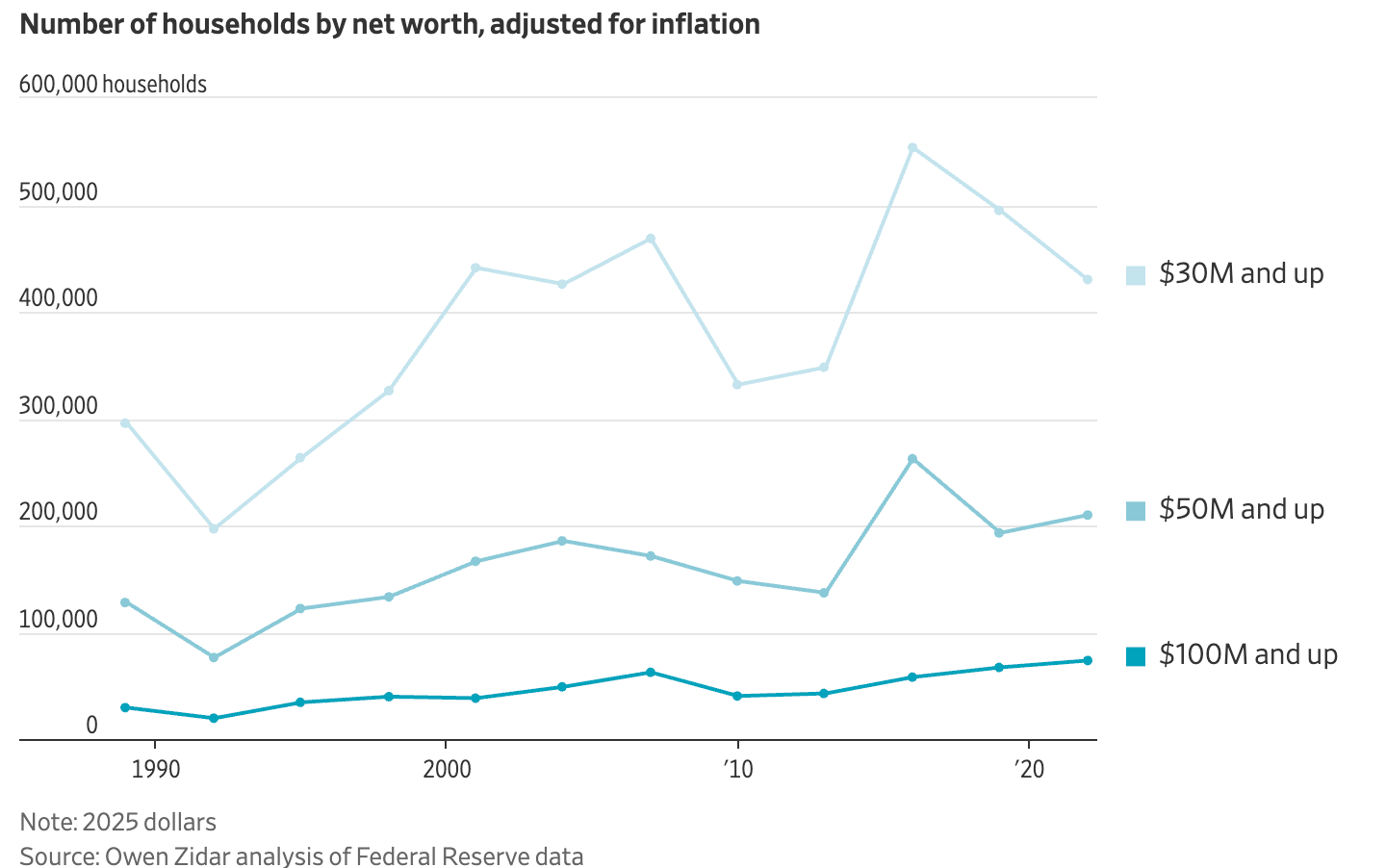
Roughly 400,000 American households now reportedly control more than $30 million in wealth. That’s large enough to support an entire parallel economy of schools, healthcare, media, real estate and services designed almost exclusively around extreme wealth. 🔗 They’re Rich but Not Famous—and They’re Suddenly Everywhere
I appreciate your intro but I think it might be wise to consider that the behavior of people acting in idiosyncratic ways is what built the blueprint for the robot to provide that kind of genre bending playlist.
People might not have named the canal, but they were almost certainly the first to chart it out and start digging. The machine may have finished the job but it didn’t establish the initial pathway.