


Good morning time travelers…
My neighbor Tom died last week. I saw him often but didn’t interact much. He wasn’t that old, but in poor health. Tom said it was because of 9/11. Toxic dust.
We just met. Or did we? Now his house sits empty.
Most people I know are dealing with aging parents, many slipping into dementia. I find myself badly missing my own. All reminders of life’s brief and violent cycles.
Time accelerates as you age. As preparation.
Spring is a potent reminder of it’s relentless pace. Spring is always good, especially in New York. Even if it reminds me that last summer feels too close.
Maybe it’s just me, but my sense of time feels off. Things used to come in segments—weekly episodes, nightly news, the morning paper, top of the charts. Events that defined a stretch of time. Life had more rhythm.
Now everything arrives at once, in a continuous stream, flattened into the same feed. Technology has compressed cycles so much that things start, peak, and disappear before they can fully register. More happens—but less sticks. Things don’t last long enough to define time.
Without pauses, without spacing, without resolution, moments don’t turn into memories the way they used to. They pass through. And when I look back, instead of a sequence, I see a blur.
RingRing… pick it up.
In other news, we’ve built a fun new texting project called RingRing. Think group text meets American Idol. Each week we will send a question and get your “takes.” Everyone votes on the best submissions. The winning response will go out to everyone on the list and be featured on the podcast. Low lift, high signal. Sign up here: https://intel.peoplevsalgorithms.com
Pod 181: The Clipping Economy
Out FRIDAY 6 AM EST Apple | Spotify | Substack
Paid clippers, algorithmic floods, and Netflix going vertical — this week we dig into how the clip has become the unit of cultural currency and whether it’s creating a mass delusion about what people actually want and what is popular. Also: a Waymo hostage situation, a vibe-coded group-texting platform, Apple vs. the interface doomers, Uber’s super app survival play, Ben Sasse’s deathbed honesty about young people’s anxiety, and what the rise of Graham Platner says about the need to be a legible character.
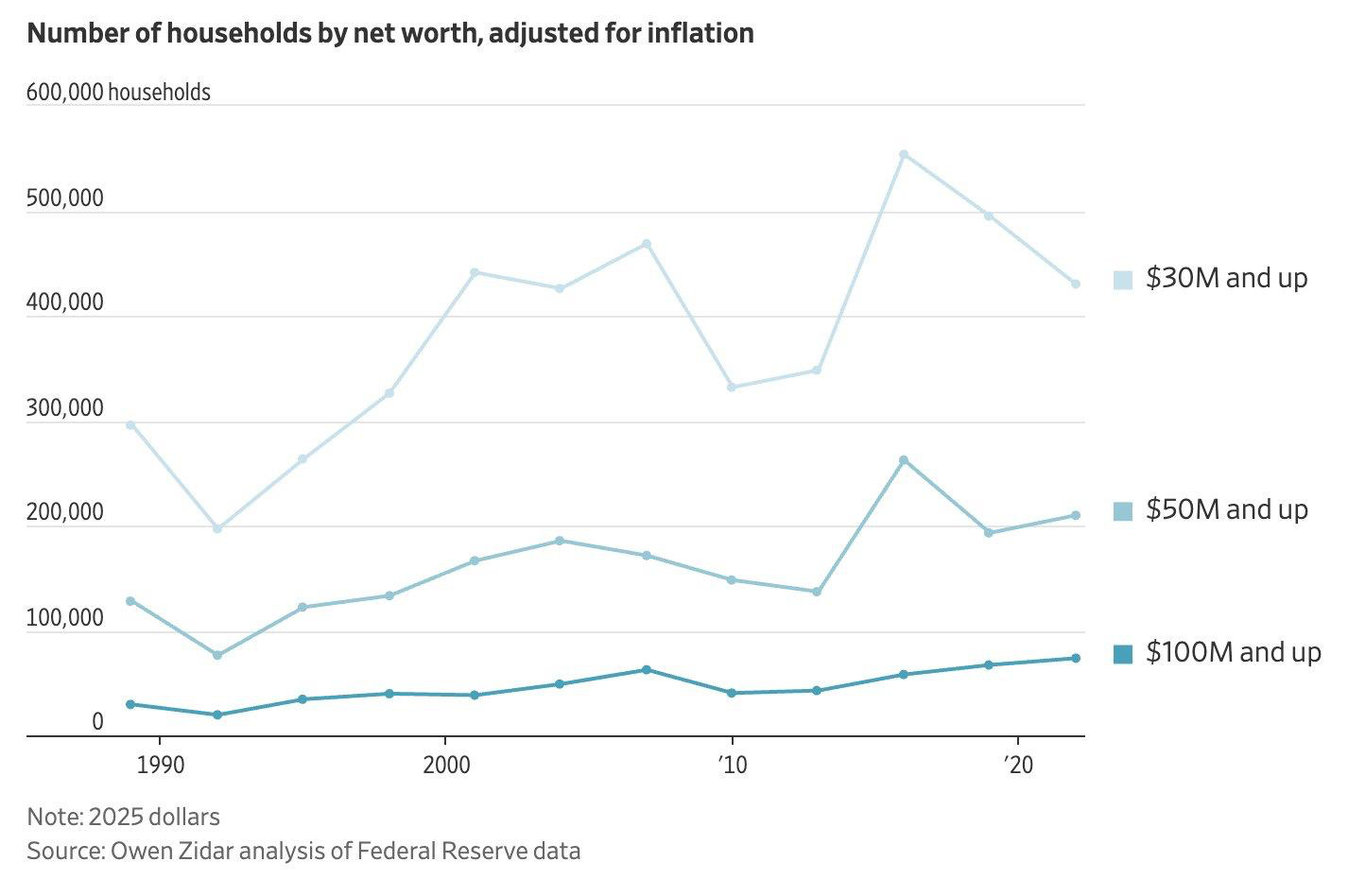
Generational Wealth
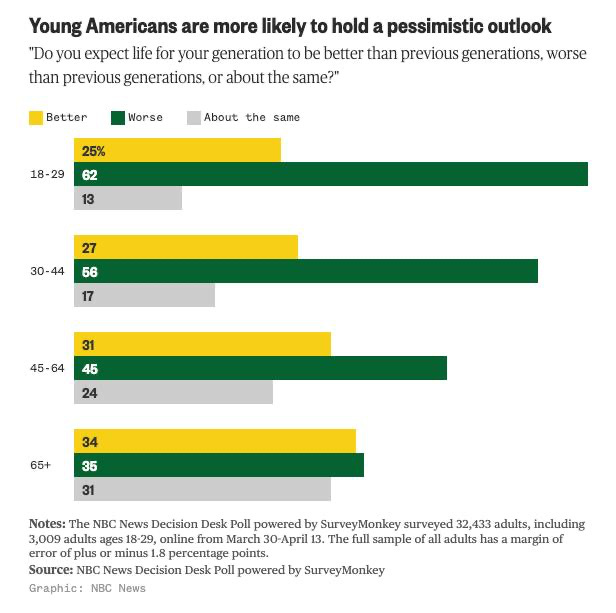
A lotta rich people in America. Sadly, not everyone shares their optimism.
1. The majority of teens and adults now get news from influencers and independent creators.
57% of teens and adults receive at least some news from influencers, with the figure rising to 81% for teens. 62% of people report actively avoiding news about Donald Trump, and 57% avoid news about national politics. 🔗 The Evolving News Landscape: Comparing Media Habits and Trust Between Teens and Adults
Signal: At the base of this food chain are reporters, reporting. Even if it’s getting harder to capture the value.
2. Looksmaxxers get legal.

Alorah Ziva, an 18-year-old ‘looksmaxxer,’ is suing streamer Braden ‘Clavicular’ Peters for alleged sexual assault, battery, and fraud. The lawsuit claims Peters assaulted Ziva when she was 16 and injected her with an unapproved substance on a livestream, causing her cheek to become ‘perforated.’ 🔗 Female Looksmaxxer Alorah Ziva Is Suing Clavicular for Alleged Battery
Signal: Never date a looksmaxxer.
3. AI carb counters are dangerously wrong.
A study of four top AI models, including OpenAI’s GPT-5.4 and Google’s Gemini 2.5 Pro, found they are dangerously unreliable for carb counting. Across 26,904 queries, models gave wildly different estimates for the same food photo; Gemini’s guess for a paella dish varied by 429g, a potentially fatal range for a diabetic. 🔗 He asked AI to count carbs 27000 times. It couldn’t give the same answer twice
Signal: We still need accountable professionals.
4. Google prospers, the open web whimpers.


Google’s Q1 earnings reveal 91% of its ad revenue now comes from its own properties, now at a run rate of over $300B annually.
Signal: You are on your own. This is capitalism.
5. OpenAI’s ‘all cylinders’ misfire.
OpenAI missed internal user and sales targets, falling short of a goal to reach 1 billion weekly ChatGPT users by 2025’s end, per The Wall Street Journal. The report comes as rival Anthropic gains ground in enterprise markets. OpenAI pushed back, stating its business is ‘firing on all cylinders.’ The news immediately sent ripples through its supply chain, with pre-market trading seeing Nvidia stock drop 1%, AMD 4%, and Oracle 5%. 🔗 AI Worries Have Returned to Wall Street. Now Come Earnings
Signal: The adults are gonna question massive data-center commitments. OpenAI success drives an entire ecosystem’s growth narrative.
6. Musk’s lawsuit stumbles.
In his Oakland trial against OpenAI, Elon Musk admitted there was no written contract for his founding donation. Musk also testified that his company, xAI, has ‘partly’ distilled OpenAI’s technology, a violation of its terms. Internal 2017 emails show Musk previously sought majority control over the company. 🔗 Is A.I. a Threat to Humanity? Not in This Trial
Signal: Musk is using the courts to re-litigate a failed takeover attempt. The record challenges his altruistic narrative.
7. Beeple makes robotic dogs with hyper-realistic silicone heads of billionaires.
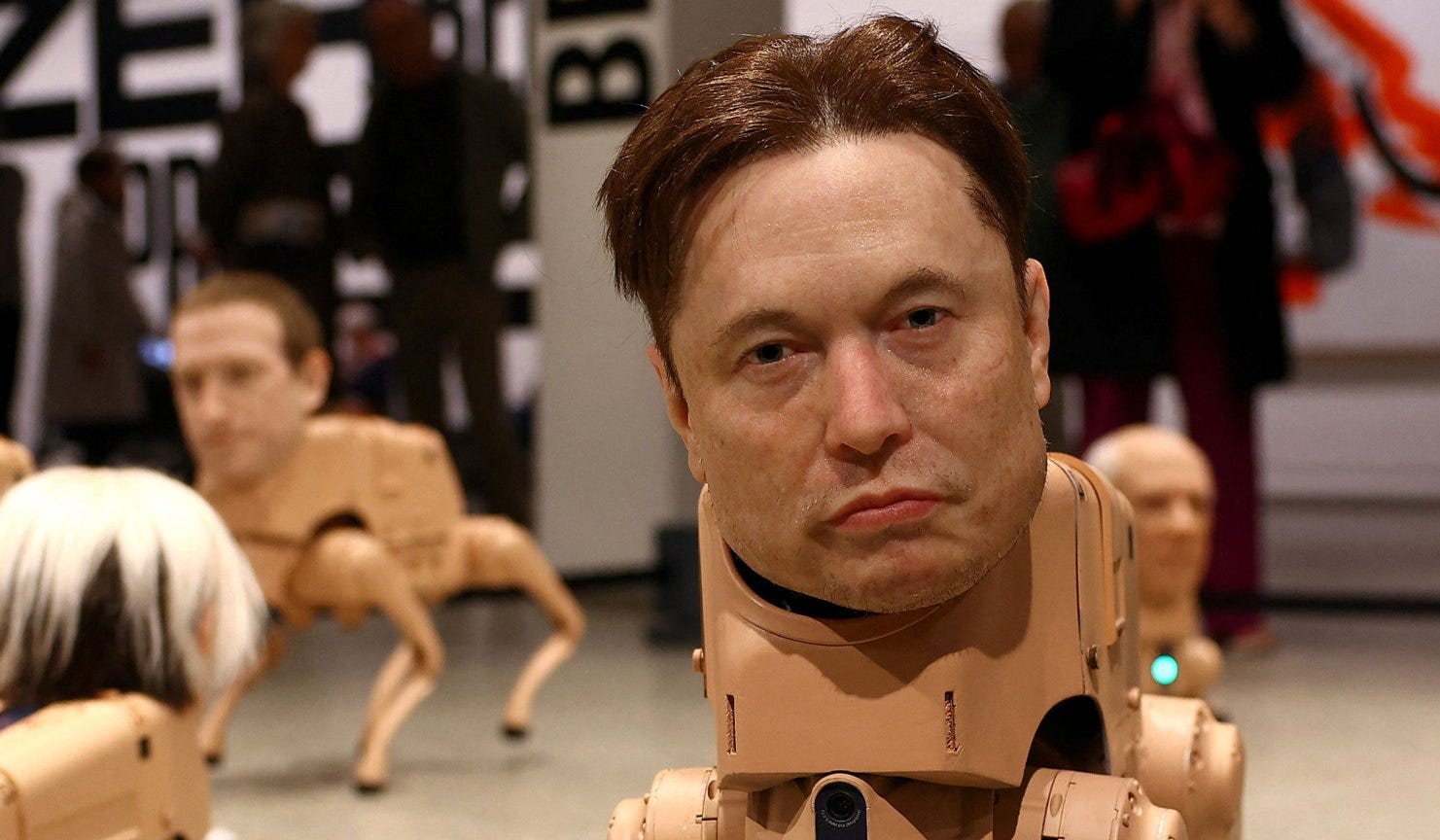
High-concept trolling that perfectly captures the current cultural sentiment towards the oligarchs portraying them as uncanny, roaming, and slightly menacing figures of power. The robot dogs feature heads modeled after Elon Musk, Mark Zuckerberg, Jeff Bezos, and Kim Jong Un. 🔗 Robot dogs with hyper-realistic silicone heads
Signal: All signal.
8. Naval Ravikant predicts Apple is “dead” within 18 months.
Within 24 months, most people will interact with an agent, not apps directly. They will generate interfaces on the fly, collapsing the value of platform ecosystems like Apple’s App Store. This shift would completely undermine Apple’s hardware premium and ecosystem lock-in. 🔗 Naval Ravikant: Apple is dead, SaaS is next, you have 18 months
Signal: Alex thinks this is malarky. You will still need a device and will pay for Apple’s elegant connectivity to you life even if the interface evolves.
9. The Ankler leaves Substack for a new platform from Ben Thompson.
As it expands beyond a newsletter into a multifaceted media company, The Ankler is adopting a new infrastructure designed for deeper audience insights, customizable offerings, and long-term business scalability, while still keeping a foothold in its Substack for distribution. 🔗 The Ankler moves to new publishing platform created by Ben Thompson
Signal: These things always evolve the same way. At some point a business has to set its own technological path to support its objectives.
10. The ‘Session’ as the successor to the ‘Page’ as the primary unit of digital experience.
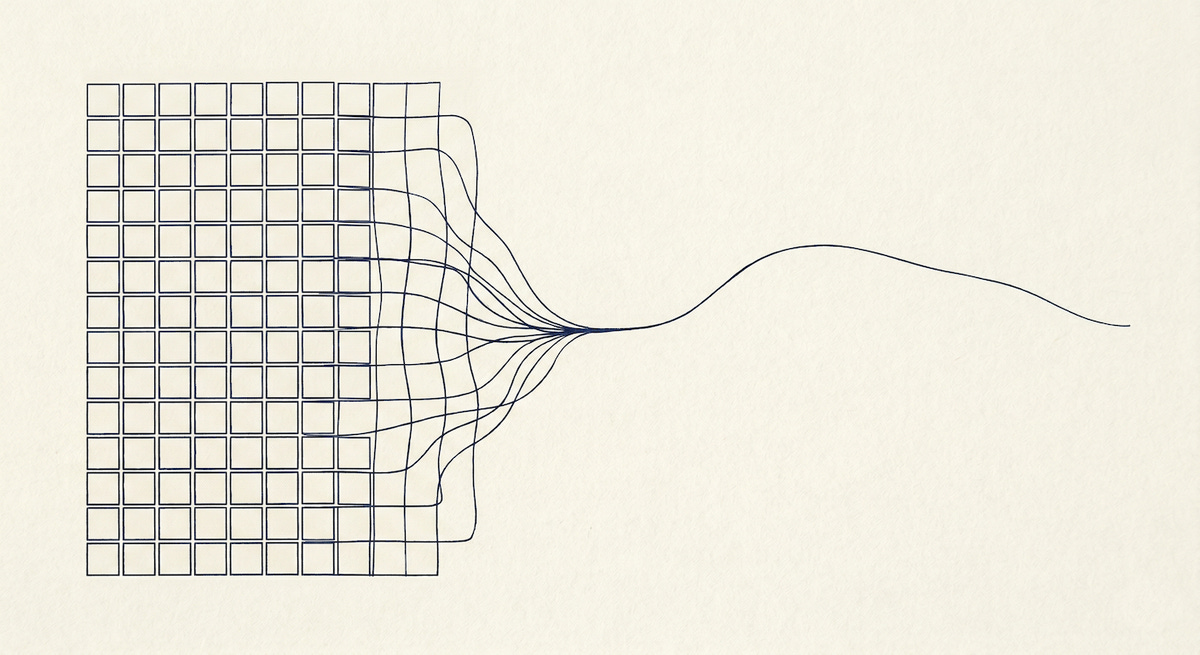
This conceptual shift from static interfaces to dynamic, conversational sessions is the theoretical underpinning of the next internet. A session is defined as “a bounded period of continuous interaction between a user and a system.” It reframes how we should design and build products in an AI-native world. 🔗 After the Page
Signal: But what about the banner ads?
11. Uber wants your whole vacation.
Uber is partnering with Expedia Group to add hotel bookings to its app, initially launching in the US. Announced at its annual product event, the company also plans to integrate vacation rentals from Expedia’s Vrbo brand later in 2026 as it pushes to become an ‘everything platform’. 🔗 Uber Can Already Bring You Dinner. Now, It Wants to Book Your Hotel Room
Signal: Waymo will push Uber harder into the booking aggregator space. Balancing single app utility with multi-modal functionality will take dexterity.
12. OpenAI is reportedly developing a dedicated AI-native phone.
An OpenAI phone would be a Trojan horse for an entirely new operating system built around agents, not apps, representing the most significant attempt to disrupt the mobile duopoly. The report comes from analyst Ming-Chi Kuo, known for accurately predicting Apple product cycles for 20 years. 🔗 OpenAI is reportedly building a phone designed to replace the iPhone.
Signal: Sounds cool until you realize the iPhone can do this too.
13. An oyster farmer’s insurgent senate campaign gains momentum in Maine.
Graham Platner represents a new archetype of influencer politician using a compelling personal narrative and direct-to-camera appeals to build a movement outside of traditional party structures. His main primary opponent, Governor Janet Mills suspended her campaign, clearing his path to the Democratic nomination.
Signal: The new political winners are characters built for the internet.
GOOD PRODUCT
From the moment I heard “Something in the Air” on Zach Galifianakis’ quirky new Netflix show, This Is a Gardening Show, it struck me… like maybe I had heard it before but needed to hear it a hundred more times.
Thanks Lucas. Happy to be your dog walking companion. Appreciate the note.
Beautifully written intro. A sentiment many feel. Funny enough this podcast is a time marker for me, a welcome into my Friday. I’m 4 days in office but home Friday, so it’s usually a more leisurely morning. I listen while I walk the dog before I start work.
You’ve got to make your own peace, pace, moments of zen. Harder these days but plenty possible.